Hypanus say, Bluntnose stingray : gamefish

You can sponsor this page

Hypanus say (Lesueur, 1817)

Bluntnose stingray
Beobachtung melden im Fish Watcher
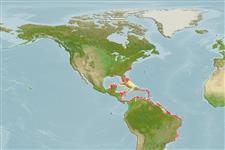
Native range
This map was computer-generated and has not yet been reviewed.
Hypanus say   AquaMaps   Data sources: GBIF OBIS
Hochladen Photos und videos
Bilder | Google Bild
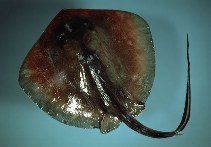
Image of Hypanus say (Bluntnose stingray)
Hypanus say
Photo von Flescher, D.

Klassifizierung / Names Namen | Synonyme | Catalog of Fishes(Gattung, Arten) | ITIS | CoL | WoRMS | Cloffa

Elasmobranchii (Haie und Rochen) (sharks and rays) > Myliobatiformes (Stingrays) > Dasyatidae (Stingrays) > Dasyatinae
Eponymy: Thomas Say (1787–1834) was a self-taught American naturalist whose primary interest was entomology. [...] (Ref. 128868), visit book page.
More on author: Lesueur.

Umwelt: Milieu / Klimazone / Tiefenbereich / Verbreitungsgebiet Ökologie

seewasser; brackwasser demersal; tiefenbereich 1 - 10 m (Ref. 55208), usually 1 - ? m (Ref. 55208). Subtropical; 45°N - 28°S, 95°W - 33°W (Ref. 55208)

Verbreitung Territorien | FAO Gebiete | Ökosysteme | Vorkommen | Punkt Karte | Einführungen | Faunafri

Western Atlantic: New Jersey (rarely in Massachusetts), USA and northern Gulf of Mexico to Argentina; widespread in the West Indies. Throughout Antilles (Ref. 26938).

Länge bei der ersten Reifung / Größe / Gewicht / Alter

Geschlechtsreife: Lm 55.0, range 50 - 60 cm
Max length : 104 cm WD Männchen/unbestimmt; (Ref. 49746)

Kurzbeschreibung Bestimmungsschlüssel | Morphologie | Morphometrie

Moderate size, with a short blunt snout. Disk has rounded corners, few tubercles and spines along midline (Ref. 26938). Well developed fold on the upper surface and lower surface of tail. Yellowish or light brown above. Lower surface whitish or pure white (Ref. 6902).
Body shape (shape guide): other.

Biologie     Fachlexikon (Englisch) (z.B. epibenthic)

Inhabits coastal waters (Ref. 7251). Generally found near shore, to depths of 10 m. Both adults and juveniles frequent estuaries and surf zones (Ref. 27549). Bottom feeder with fish, clams, worms and shrimps. It causes a number of injuries to bathers and waders (Ref. 26938). Ovoviviparous (Ref. 50449). Litters of 2-4 pups; gestation 10-11 months, including a period of embryonic diapause (Ref. 114953).

Lebenszyklus und Paarungsverhalten Geschlechtsreife | Fortpflanzung | Ablaichen | Eier | Fruchtbarkeit | Larven

Exhibit ovoviparity (aplacental viviparity), with embryos feeding initially on yolk, then receiving additional nourishment from the mother by indirect absorption of uterine fluid enriched with mucus, fat or protein through specialised structures (Ref. 50449). Distinct pairing with embrace (Ref. 205).

Hauptreferenz Laden Sie Ihre Referenzen hoch | Referenzen | Koordinator : McEachran, John | Partner

Compagno, L.J.V., 1999. Checklist of living elasmobranchs. p. 471-498. In W.C. Hamlett (ed.) Sharks, skates, and rays: the biology of elasmobranch fishes. Johns Hopkins University Press, Maryland. (Ref. 35766)

IUCN Rote Liste Status (Ref. 130435: Version 2025-2 (Global))

  Gefährdung zunehmend (NT) (A2bd); Date assessed: 21 June 2019

CITES

Not Evaluated

CMS (Ref. 116361)

Not Evaluated

Bedrohung für Menschen

  Traumatogenic (Ref. 4716)


Nutzung durch Menschen

Sportfisch: ja
FAO - Publication: search | FishSource | Das Meer um uns herum

Mehr Information

Trophische Ökologie
Lebensmittel (Beutetiere)
Nahrungszusammensetzung
Nahrungsaufnahme
Lebensmittelrationen
Räuber
Ökologie
Ökologie
Populationsdynamik
Wachstumsparameter
Max. Alter/Größen
Länge-Gewicht-Rel.
Länge-Länge-Verhältnis.
Längenhäufigkeiten
Massenkonvertierung
Rekrutierung
Dichte
Lebenszyklus
Fortpflanzung
Geschlechtsreife
Reifung/Kiemen rel.
Fruchtbarkeit
Ablaichen
Laichaggregationen
Eier
Eientwicklung
Larven
Larven Pop.Dyn.
Verbreitung
Territorien
FAO Gebiete
Ökosysteme
Vorkommen
Einführungen
BRUVS - Videos
Anatomie
Kiemenoberfläche
Gehirn
Otolith
Physiologie
Körperliche Zusammensetzung
Nährstoffe
Sauerstoffverbrauch
Schwimmart
Schwimmgeschwindigkeit
Visuelle Pigmente
Fischgeräusche
Krankheiten und Parasiten
Toxizität (LC50s)
Genetik
Genom
Genetik
Heterozygotie
Vererbbarkeit
Genetische Vielfalt
Menschenbezogen
Aquakultur-Systeme
Aquakultur Profile
Zuchtlinien
Ciguatera-Fälle
Briefmarken, Münzen, Verschiedenes.
Aufsuchen
Partner
Referenzen
Referenzen

Tools

Zusatzinformationen

Download XML

Internet Quellen

AFORO (otoliths) | Aquatic Commons | BHL | Cloffa | Websites from users | FishWatcher Einträge suchen | CISTI | Catalog of Fishes: Gattung, Arten | DiscoverLife | ECOTOX | FAO - Publication: search | Faunafri | Fishipedia | Fishtrace | GloBI | Google Books | Google Scholar | Google | IGFA World Record | Nationale Datenbanken | OceanAdapt | OneZoom | Open Tree of Life | Otolith Atlas of Taiwan Fishes | PubMed | Reef Life Survey | Socotra Atlas | TreeBase | Tree of Life | Wikipedia: Gehe zu, Suchen | World Records Freshwater Fishing | Zoologischer Rekord

Schätzungen auf der Grundlage von Modellen

Bevorzugte Temperatur (Ref. 123201): 23.1 - 28.1, mean 27.1 °C (based on 760 cells).
Phylogenetischer Diversitätsindex (Ref. 82804):  PD50 = 0.5010   [Uniqueness, from 0.5 = low to 2.0 = high].
Bayesian length-weight: a=0.00447 (0.00189 - 0.01058), b=3.12 (2.92 - 3.32), in cm total length, based on LWR estimates for this (Sub)family-body shape (Ref. 93245).
Trophische Ebene (Ref. 69278):  3.7   ±0.2 se; based on diet studies.
Widerstandsfähigkeit (Ref. 120179):  niedrig, Verdopplung der Population dauert 4,5 - 14 Jahre. (Assuming fecundity<100).
Anfälligkeit der Fischerei (Ref. 59153):  Very high vulnerability (90 of 100). 🛈
Nährstoffe (Ref. 124155):  Calcium = 26.4 [3.6, 122.6] mg/100g; Iron = 0.744 [0.197, 2.068] mg/100g; Protein = 23.9 [21.1, 26.5] %; Omega3 = 0.23 [0.06, 0.69] g/100g; Selenium = 12.5 [3.8, 37.8] μg/100g; VitaminA = 9.03 [3.46, 23.49] μg/100g; Zinc = 0.738 [0.357, 1.351] mg/100g (wet weight);