वर्गीकरण / नाम
आम नाम | उपशब्द | Catalog of Fishes(वर्ग, प्रजाति) | ITIS | CoL | WoRMS | Cloffa
इलाज़मौबरांकी (शारक और रेज़) (sharks and rays) >
Myliobatiformes (Stingrays) >
Dasyatidae (Stingrays) > Dasyatinae
Eponymy: Thomas Say (1787–1834) was a self-taught American naturalist whose primary interest was entomology. [...] (Ref. 128868), visit book page.
More on author: Lesueur.
पर्यावरण: पर्यावरण / जलवायु क्षेत्र / गहराई सीमा / वितरण सीमा
पारिस्थितिकी
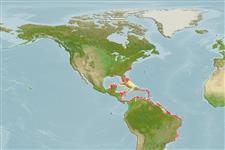
समुद्री; खारा ड़िमरसल; गहराई सीमा 1 - 10 m (Ref. 55208), usually 1 - ? m (Ref. 55208). Subtropical; 45°N - 28°S, 95°W - 33°W (Ref. 55208)
Western Atlantic: New Jersey (rarely in Massachusetts), USA and northern Gulf of Mexico to Argentina; widespread in the West Indies. Throughout Antilles (Ref. 26938).
प्रथम परिपक्वता पर लंबाई / आकार / वज़न / आयु
परिपक्व अवधि: Lm 55.0, range 50 - 60 cm
Max length : 104 cm WD पुल्लिंग / अलिंग; (Ref. 49746)
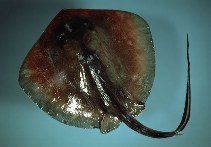
Moderate size, with a short blunt snout. Disk has rounded corners, few tubercles and spines along midline (Ref. 26938). Well developed fold on the upper surface and lower surface of tail. Yellowish or light brown above. Lower surface whitish or pure white (Ref. 6902).
Body shape (shape guide): other.
Inhabits coastal waters (Ref. 7251). Generally found near shore, to depths of 10 m. Both adults and juveniles frequent estuaries and surf zones (Ref. 27549). Bottom feeder with fish, clams, worms and shrimps. It causes a number of injuries to bathers and waders (Ref. 26938). Ovoviviparous (Ref. 50449). Litters of 2-4 pups; gestation 10-11 months, including a period of embryonic diapause (Ref. 114953).
जीवन चक्र और संभोग व्यवहार
परिपक्व अवधि | पुनरुत्पत्ति | मछलीऔ का अंडे देना | अंडे | उपजाऊपन | लार्वा
Exhibit ovoviparity (aplacental viviparity), with embryos feeding initially on yolk, then receiving additional nourishment from the mother by indirect absorption of uterine fluid enriched with mucus, fat or protein through specialised structures (Ref. 50449). Distinct pairing with embrace (Ref. 205).
Compagno, L.J.V., 1999. Checklist of living elasmobranchs. p. 471-498. In W.C. Hamlett (ed.) Sharks, skates, and rays: the biology of elasmobranch fishes. Johns Hopkins University Press, Maryland. (Ref. 35766)
आईयूसीएन रेड लिस्ट स्थिति (Ref. 130435: Version 2025-2 (Global))
मनुष्यों के लिए ख़तरा
Traumatogenic (Ref. 4716)
मानव उपयोग
आखेट मत्स्य: हां
साधन
विशेष रिपोर्ट
XML डाउनलोड करें
इंटरनेट स्रोत
मॉडल पर आधारित अनुमान
पसंदीदा तापमान (संदर्भ
123201): 23.1 - 28.1, mean 27.1 °C (based on 760 cells).
जातिवृति विविधता सूचकांक (संदर्भ
82804): PD
50 = 0.5010 [Uniqueness, from 0.5 = low to 2.0 = high].
Bayesian length-weight: a=0.00447 (0.00189 - 0.01058), b=3.12 (2.92 - 3.32), in cm total length, based on LWR estimates for this (Sub)family-body shape (Ref.
93245).
ट्रॉफिक स्तर (संदर्भ
69278): 3.7 ±0.2 se; based on diet studies.
लौटाव (संदर्भ
120179): निम्न, न्यूनतम जनसंख्या दुगनी होने का समय 4.5 - 14 वर्ष। (Assuming fecundity<100).
मछली पकड़ने की भेद्यता (Ref.
59153): Very high vulnerability (90 of 100).
🛈
पोषक तत्व (Ref.
124155): Calcium = 26.4 [3.6, 122.6] mg/100g; Iron = 0.744 [0.197, 2.068] mg/100g; Protein = 23.9 [21.1, 26.5] %; Omega3 = 0.23 [0.06, 0.69] g/100g; Selenium = 12.5 [3.8, 37.8] μg/100g; VitaminA = 9.03 [3.46, 23.49] μg/100g; Zinc = 0.738 [0.357, 1.351] mg/100g (wet weight);