>
Eupercaria/misc (Various families in series Eupercaria) >
Lutjanidae (Snappers) > Lutjaninae
Etymology: Lutjanus: Malay, ikan lutjan, name of a fish.
More on author: Forster.
Milieu: milieu / Klimaatzone / Diepte / verspreidingsgebied
Ecologie
marien; zoet water; brak water rifbewoner; diepte 1 - 80 m (Ref. 9710). Tropical; 20°C - 28°C; 34°N - 34°S, 28°E - 134°W (Ref. 55)
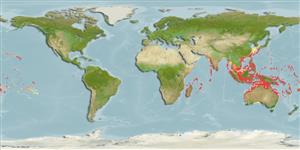
Indo-Pacific: East Africa to the Marquesas and Line islands, north to southern Japan, south to Australia (Ref. 9821). Records from the Red Sea and Persian Gulf are outside distributional range (Ref. 114545).
Lengte bij maturiteit / Grootte / Gewicht / Leeftijd
Maturiteit: Lm 20.6 range ? - ? cm
Max length : 40.0 cm TL mannelijk / geslacht onbekend; (Ref. 55); common length : 25.0 cm TL mannelijk / geslacht onbekend; (Ref. 30573); max. gepubliceerd gewicht: 820.00 g (Ref. 132370); max. gerapporteerde leeftijd: 34 Jaren (Ref. 107771)
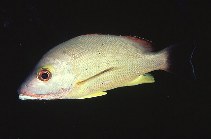
Dorsale stekels (totaal) : 10; Dorsale zachte stralen (totaal) : 14; Anale stekels: 3; Anale zachte stralen: 8. This species is distinguished by the following characters: body with greatest depth 2.3-2.8 in SL; preopercular notch and knob well developed; vomerine tooth patch crescentic, without a medial posterior extension; tongue smooth, without teeth; gill rakers of first gill arch 6-7 + 10-14 = 16-20 (including rudiments); caudal fin slightly emarginate; scale rows on back rising obliquely above lateral line. Colour of back and sides tan, grey to brownish, sides usually with a series of narrow yellow of golden-brown stripes, 1 per scale rows, caudal fin blackish, dorsal and caudal fins with a narrow white border; pectoral, pelvic and anal fins yellowish, and a broad yellow rim around posterior eye (Ref. 9821, 90102).
Body shape (shape guide): fusiform / normal; Cross section: oval.
Adults inhabit lagoon and semi-protected seaward reefs (Ref. 9710). They prefer sheltered areas with deep holes or large boulders (Ref. 37816). Benthopelagic (Ref. 58302). Solitary or in loose aggregations (Ref. 90102). Juveniles sometimes found in shallow mangrove swamps and the lower parts of freshwater streams. Adults feed at night on fishes, shrimps, crabs, holothurians and cephalopods (Ref. 30573). Commonly seen in markets, usually fresh. Caught with handlines, traps, and gill nets. This fish sometimes causes ciguatera poisoning, particularly in the Pacific portion of its range (Ref. 9821). Maximum depth reported taken from Ref. 9773.
Allen, G.R., 1985. FAO Species Catalogue. Vol. 6. Snappers of the world. An annotated and illustrated catalogue of lutjanid species known to date. FAO Fish. Synop. 125(6):208 p. Rome: FAO. (Ref. 55)
Status op de Rode Lijst van het IUCN (Ref. 130435: Version 2025-2 (Global))
Gevaar voor de mens
Reports of ciguatera poisoning (Ref. 4690)
Gebruik door de mens
Visserij: commercieel; sportvis: ja; Aquarium: Commercieel
Tools
Speciale rapporten
Download XML
Internetbronnen
Schattingen op basis van modellen
Gewenste temperatuur (Ref.
123201): 24.6 - 29, mean 28 °C (based on 1452 cells).
Fylogenetische diversiteitsindex (Ref.
82804): PD
50 = 0.5000 [Uniqueness, from 0.5 = low to 2.0 = high].
Bayesian length-weight: a=0.01549 (0.01369 - 0.01753), b=2.97 (2.95 - 2.99), in cm total length, based on LWR estimates for this species (Ref.
93245).
Trofisch niveau (Ref.
69278): 3.6 ±0.5 se; based on diet studies.
Weerstandsvermogen (Ref.
120179): Zeer laag, minimale populatieverdubbelingstijd meer dan 14 jaar (K=0.04-0.4; tmax=34; tm=3-4; Fec >10,000).
Kwetsbaarheid van de visserij (Ref.
59153): Low to moderate vulnerability (29 of 100).
🛈
Voedingsstoffen (Ref.
124155): Calcium = 40.1 [27.1, 56.7] mg/100g; Iron = 0.352 [0.232, 0.560] mg/100g; Protein = 18.6 [17.2, 19.9] %; Omega3 = 0.147 [0.108, 0.203] g/100g; Selenium = 59.4 [38.6, 95.1] μg/100g; VitaminA = 127 [24, 445] μg/100g; Zinc = 0.576 [0.459, 0.786] mg/100g (wet weight); based on
nutrient studies.