>
Anabantiformes (Gouramies, snakeheads) >
Osphronemidae (Gouramies) > Osphroneminae
Etymology: Osphronemus: Greek, osphra = smell + Greek, nema = filament; because of the olfactory organs (Ref. 45335).
More on author: Roberts.
Miljö: miljö / Klimatzon / djupintervall / distributionsområde
Ekologi
; sötvatten pelagiska; flodvandrande (Ref. 138296). Tropical
Asia: known only from the Mekong basin.
Storlek / Vikt / Ålder
Könsmognad: Lm ? range ? - ? cm
Max length : 60.0 cm SL hane/ej könsbestämd; (Ref. 30857)
Kort beskrivning
Bestämningsnycklar | Morfologi | Morfometri
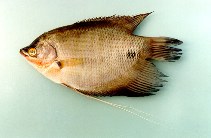
Taggstrålar i ryggfenan (totalt) : 14 - 16; Mjukstrålar i ryggfenan (totalt) : 10 - 11; Taggstrålar i analfenan: 11 - 13; Mjukstrålar i analfenan: 17 - 19. Differs from the other three known species of Osphronemus in having oral teeth increasingly enlarged and externalized in large adults, a condition apparently unique within anabantoid fishes. In large specimens examined, over 40 cm SL, all of the jaw teeth are enlarged, especially those in the outermost rows, which lie on the external surface of the jaws entirely outside the mouth when it is shut. Coloration of juveniles and adults also is diagnostic. Small juveniles have 6 or 7 vertical bars and a supra-anal dark oval spot, none of which are retained by adults and subadults. Juveniles over about 10 cm have a reddish orangish stripe on the lower part of the head and breast, a feature not observed in any other species. All adults have extensive dark (almost black) areas ventrally and pale areas dorsally. Several large specimens (especially from Stung Treng market, Cambodia) with large and irregular red blotches that superficially at least look very muck like bodied bruises.
Body shape (shape guide): short and / or deep.
Obligate air-breathing (Ref. 126274); Occurs in pools of large rivers and in flooded forests during the rainy season. Feeds mainly on plant matter including fruits, leaves, and flowers, with some insects and crustaceans. Known to reproduce in non-flowing waters near the river shore during lowest water levels (Ref. 12693). Undertakes lateral migrations from the Mekong mainstream into floodplain areas during the flood season and returns to the Mekong River or other permanent water bodies during the dry season (Ref. 37770). These movements are triggered when water levels change (Ref. 37770). Marketed fresh (Ref. 12693).
Livscykel och parningsbeteende
Könsmognad | Reproduktion | Lek | Ägg | Fekunditet | Larver
Builds a small nest, made of leaves and roots of a plant named "gohk kai" in Takam, just below the Lee Pee Waterfalls in southern Laos. Eggs and young are guarded by one parent as observed in the Mekong basin at Stung Treng.
Rainboth, W.J., 1996. Fishes of the Cambodian Mekong. FAO species identification field guide for fishery purposes. FAO, Rome, 265 p. (Ref. 12693)
Status på IUCN:s rödlista (Ref. 130435: Version 2025-2 (Global))
Hot mot människor
Harmless
Mänskliga användningsområden
Fiskeri: kommersiell
Verktyg
Särskilda rapporter
Ladda ner XML
Internet-källor
Uppskattningar baserade på modeller
Index för fylogenetisk mångfald (Ref.
82804): PD
50 = 0.5625 [Uniqueness, from 0.5 = low to 2.0 = high].
Bayesian length-weight: a=0.01698 (0.00686 - 0.04207), b=3.01 (2.79 - 3.23), in cm total length, based on LWR estimates for this (Sub)family-body shape (Ref.
93245).
Trofisk nivå (Ref.
69278): 2.7 ±0.29 se; based on food items.
Resiliens (Ref.
120179): Mellan, lägsta populationsfördubblingstid 1,4-4,4 år (Fec = 1,240).
Sårbarhet i fisket (Ref.
59153): Moderate to high vulnerability (49 of 100).
🛈