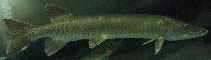
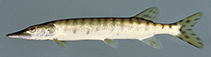
>
Esociformes (Pikes and mudminnows) >
Esocidae (Pikes)
Etymology: Esox: From Greek, isox and also related with the Celtic root, eog, ehawc = salmon (Ref. 45335); masquinongy: Stemmed from an Ojibwa (Chippewa) Indian name for this fish (Ref. 10294).
More on author: Mitchill.
Milieu: milieu / Klimaatzone / Diepte / verspreidingsgebied
Ecologie
; zoet water demersaal; potamodroom (Ref. 126106). Temperate; 53°N - 30°N
North America: Native to St. Lawrence River - Great Lakes, Hudson Bay (Red River), and Mississippi River basins. Introduced elsewhere in the USA. Native populations are protected in portions of Tennessee and Ohio.
Lengte bij maturiteit / Grootte / Gewicht / Leeftijd
Maturiteit: Lm 77.0 range ? - ? cm
Max length : 183 cm TL mannelijk / geslacht onbekend; (Ref. 5723); common length : 95.0 cm TL mannelijk / geslacht onbekend; (Ref. 12193); max. gepubliceerd gewicht: 31.8 kg (Ref. 3549); max. gerapporteerde leeftijd: 30 Jaren (Ref. 26373)
Adults live in clear vegetated lakes, quiet pools and backwaters of creeks and small to large rivers (Ref. 205, 10294). Solitary, lurking hunter on other fishes as well as on ducklings, muskrats, and snakes. Oviparous, spawn in spring as the ice melts (Ref. 205).
Some experts believe that some form of copulation happens during breeding of this species. The female turns on her side to expose her abdomen to the male who then swims against her in a forceful movement. Aftewards, the female takes a rest and deposits her eggs in the sand. This whole activity is presumably repeated one more time (Ref. 205). Other experts believe otherwise, that only a simple and simultaneous discharge of gametes happens during breeding (Ref. 205).
Crossman, E.J., 1996. Taxonomy and distribution. p. 1-11. In J.F. Craig (ed.) Pike biology and exploration. Chapman and Hall, London. 298 p. (Ref. 26373)
Status op de Rode Lijst van het IUCN (Ref. 130435: Version 2025-2 (Global))
Gevaar voor de mens
Harmless
Gebruik door de mens
Visserij: commercieel; Aquacultuur: commercieel; sportvis: ja; Aquarium: Publieke aquaria
Tools
Speciale rapporten
Download XML
Internetbronnen
Schattingen op basis van modellen
Fylogenetische diversiteitsindex (Ref.
82804): PD
50 = 0.5157 [Uniqueness, from 0.5 = low to 2.0 = high].
Bayesian length-weight: a=0.00490 (0.00371 - 0.00646), b=3.08 (3.02 - 3.14), in cm total length, based on LWR estimates for this species (Ref.
93245).
Trofisch niveau (Ref.
69278): 4.5 ±0.3 se; based on diet studies.
Generation time: 6.4 (5.5 - 7.1) years. Estimated as median ln(3)/K based on 25
growth studies.
Weerstandsvermogen (Ref.
120179): laag, minimale populatieverdubbelingstijd 4,5-14 jaar (K=0.07-0.15; tmax=30).
Kwetsbaarheid van de visserij (Ref.
59153): High to very high vulnerability (67 of 100).
🛈