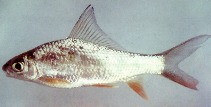
Classification / Noms
Noms communs | Synonymes | Catalog of Fishes(Genre, Espèce) | ITIS | CoL | WoRMS | Cloffa
>
Cypriniformes (Carps) >
Cyprinidae (Minnows or carps) > Labeoninae
Etymology: Cirrhinus: Latin, cirrus = curl fringe (Ref. 45335).
Eponymy: The etymology only helps to the extent that a ‘J Jullien’ collected both holotypes. [...] (Ref. 128868), visit book page.
More on author: Sauvage.
Taxonomic Remarks
This species is synonym of Cirrhinus molitorella/i> (Valenciennes, 1844) in Eschmeyer (CofF ver. May 2011: Ref. 86870) following Zhang et al. in Yue (2000: Ref. 45621). Please send references, or more studies are needed.
Environnement : milieu / zone climatique / profondeur / gamme de distribution
Écologie
; eau douce; saumâtre benthopélagique; potamodrome (Ref. 51243). Tropical
Asia: Chao Phraya and lower Mekong basins.
Taille / Poids / Âge
Maturité: Lm ? range ? - ? cm
Max length : 20.0 cm SL mâle / non sexé; (Ref. 33488)
Épines dorsales (Total) : 0; Rayons mous dorsaux (Total) : 14 - 16; Vertèbres: 34 - 35. Predorsal profile relatively steep; rostral barbels well developed, length more than one-half eye diameter; maxillary barbels absent. Somewhat similar to the much larger species C. molitorella, from where it differs markedly in coloration. Also, it is deeper bodied, especially anteriorly, and has a larger, more falcate anal fin, the distal end of which extends posteriorly to below posteriormost scales on caudal fin (Ref. 33488); 13-14 branched dorsal-fin rays; 65-68 gill rakers on lower arm of first arch; faint dark blotch on body above pectoral fin; smooth upper lip, lower lip weakly papillate (Ref. 12693). Body without reticulate pattern; pectoral, pelvic, anal and lower caudal lobe usually bright red (Ref. 43281).
Body shape (shape guide): fusiform / normal.
Inhabits midwater to bottom depths of rivers, occurring in the main stem and on the floodplains, including freshwater areas that undergo tidal fluctuation. Feeds on algae, detritus and occasionally benthic invertebrates. Often marketed fresh and used to make prahoc (Ref. 12693).
Cycle de vie et comportement reproducteur
Maturité | Reproduction | Frai | Œufs | Fécondité | Larves
Roberts, T.R., 1997. Systematic revision of the tropical Asian labeon cyprinid fish genus Cirrhinus, with descriptions of new species and biological observations on C. lobatus. Nat. Hist. Bull. Siam Soc. 45:171-203. (Ref. 33488)
Statut dans la liste rouge de l'IUCN (Ref. 130435: Version 2025-2 (Global))
Menace pour l'homme
Harmless
Utilisations par l'homme
Pêcheries: commercial
Outils
Articles particuliers
Télécharger en XML
Sources Internet
Estimations basées sur des modèles
Indice de diversité phylogénétique (Réf.
82804): PD
50 = 0.5020 [Uniqueness, from 0.5 = low to 2.0 = high].
Bayesian length-weight: a=0.00813 (0.00422 - 0.01564), b=3.06 (2.90 - 3.22), in cm total length, based on LWR estimates for this species & (Sub)family-body (Ref.
93245).
Niveau trophique (Réf.
69278): 2.5 ±0.24 se; based on food items.
Résilience (Réf.
120179): Milieu, temps minimum de doublement de population : 1,4 à 4,4 années (Preliminary K or Fecundity.).
Vulnérabilité de la pêche (Ref.
59153): Low vulnerability (14 of 100).
🛈