Klassifizierung / Names
Namen | Synonyme | Catalog of Fishes(Gattung, Arten) | ITIS | CoL | WoRMS | Cloffa
>
Stomiiformes (Lightfishes and dragonfishes) >
Stomiidae (Barbeled dragonfishes) > Melanostomiinae
Etymology: Leptostomias: Greek, leptos = thin + Greek, stoma = mouth (Ref. 45335).
More on authors: Regan & Trewavas.
Umwelt: Milieu / Klimazone / Tiefenbereich / Verbreitungsgebiet
Ökologie
seewasser pelagic-oceanic. Deep-water
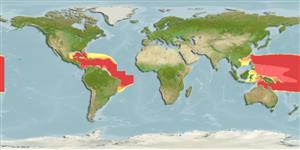
Western Pacific: Papua New Guinea. Leptostomias gracilis, Leptostomias macropogon, Leptostomias longibarba, Leptostomias bermudensis, Leptostomias analis and Leptostomias leptobolus are probably synonyms of a single species (the entire complex needs a thorough study, Ref. 4468).
Größe / Gewicht / Alter
Geschlechtsreife: Lm ? range ? - ? cm
Max length : 11.5 cm SL Männchen/unbestimmt; (Ref. 37039)
Kurzbeschreibung
Bestimmungsschlüssel | Morphologie | Morphometrie
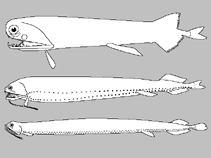
Rückenflossenweichstrahlen (insgesamt) : 20; Afterflossenweichstrahlen: 25. Body very elongate and slender. Short, blunt nonprotrusible snout. Very long chin barbel bearing filaments on base of stem (Ref. 37039).
Body shape (shape guide): elongated.
Lebenszyklus und Paarungsverhalten
Geschlechtsreife | Fortpflanzung | Ablaichen | Eier | Fruchtbarkeit | Larven
Kailola, P.J., 1987. The fishes of Papua New Guinea. A revised and annotated checklist. Vol. 1. Myxinidae to Synbranchidae. Research Bulletin No. 41. Department of Fisheries and Marine Resources, Port Moresby, Papua New Guinea. 194 p. (Ref. 6993)
IUCN Rote Liste Status (Ref. 130435: Version 2025-2 (Global))
Bedrohung für Menschen
Harmless
Nutzung durch Menschen
Tools
Zusatzinformationen
Download XML
Internet Quellen
Schätzungen auf der Grundlage von Modellen
Bevorzugte Temperatur (Ref.
123201): 26 - 28.8, mean 27.5 °C (based on 500 cells).
Phylogenetischer Diversitätsindex (Ref.
82804): PD
50 = 0.5002 [Uniqueness, from 0.5 = low to 2.0 = high].
Bayesian length-weight: a=0.00302 (0.00115 - 0.00790), b=3.11 (2.88 - 3.34), in cm total length, based on LWR estimates for this (Sub)family-body shape (Ref.
93245).
Trophische Ebene (Ref.
69278): 4.2 ±0.73 se; based on food items.
Widerstandsfähigkeit (Ref.
120179): hoch, Verdopplung der Population dauert weniger als 15 Monate. (Preliminary K or Fecundity.).
Anfälligkeit der Fischerei (Ref.
59153): Low vulnerability (10 of 100).
🛈