Περιβάλλον: περιβάλλον / κλιματική ζώνη / εύρος βάθους / εύρος διανομής
Οικολογία
Θαλασσινό(ά); Γλυκού νερού; Υφάλμυρο βενθικό(ς); ωκεανόδρομο(ς); εύρος βάθους ? - 800 m (Ref. 100719), usually ? - 300 m (Ref. 9942). Subtropical; 47°N - 4°S, 30°E - 143°E (Ref. 54598)
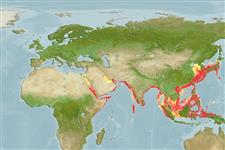
Indo-West Pacific: Red Sea, Persian Gulf, west coast of India, and Sri Lanka to Fiji and Tuvalu (Ref. 12596), north to Japan and Korea, south to the Arafura Sea (Ref. 9819) and northern Australia. Migrated to the Mediterranean via the Suez Canal (Ref. 6724).
Μέγεθος / Βάρος / Ηλικία
Γεννητική Ωρίμανση: Lm ? range ? - ? cm
Max length : 220 cm TL αρσενικό/απροσδιόριστο; (Ref. 559); common length : 80.0 cm TL αρσενικό/απροσδιόριστο; (Ref. 3397); μεγ. αναφερόμενη ηλικία: 15 έτη (Ref. 72462)
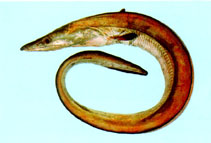
Ραχιαίες άκανθες (συνολικά) : 0; Εδρικές άκανθες: 0; Σπόνδυλοι: 145 - 159. Snout long; eye diameter 2-2.5 times in snout length; posterior nostrils much closer to eyes than to anterior nostrils; mouth very large; teeth generally large and conspicuous (Ref. 4832). Head broader, interorbital about 8 times in head; lateral-line pores before anus 44-47; dorsal-fin rays before anus 66-78; vertebrae 145-159 (Ref. 9830).
Body shape (shape guide): eel-like.
Occurs from the littoral zone to the upper bathy-benthic region (Ref. 9942, 11230). Inhabits soft bottoms (Ref. 11230), also found in estuaries. Sometimes enters freshwater environment (Ref. 9987). Feeds on small bottom fishes and crustaceans. Captured and cultured for fishery in Japan. Marketed mainly fresh (Ref. 7238). Also used as bait for shark fishing (Ref. 2872). Also caught by bag (dol) nets. Used in Chinese medicine (Ref. 12166).
Masuda, H., K. Amaoka, C. Araga, T. Uyeno and T. Yoshino, 1984. The fishes of the Japanese Archipelago. Vol. 1. Tokai University Press, Tokyo, Japan. 437 p. (text). (Ref. 559)
Κατάσταση Κόκκινου Καταλόγου IUCN (Ref. 130435: Version 2025-2 (Global))
Απειλή για τον άνθρωπο
Harmless
Ανθρώπινες χρήσεις
αλιεία: πολύ εμπορικό; Υδατοκαλλιέργειες: Εμπορικό(ά); αλιεία αναψυχής: ναί; δόλωμα: occasionally
Εργαλεία
Ειδικές εκθέσεις
Λήψη XML
Διαδικτυακές πηγές
Εκτιμήσεις βάσει μοντέλων
Προτιμώμενη θερμοκρασία (Αναφ.
123201): 11.6 - 23.2, mean 17.4 °C (based on 401 cells).
Δείκτης φυλογενετικής ποικιλότητας (Αναφ.
82804): PD
50 = 0.6250 [Uniqueness, from 0.5 = low to 2.0 = high].
Bayesian length-weight: a=0.00427 (0.00165 - 0.01106), b=3.07 (2.86 - 3.28), in cm total length, based on LWR estimates for this (Sub)family-body shape (Ref.
93245).
Τροφικό Επίπεδο (Αναφ.
69278): 4.4 ±0.67 se; based on food items.
Generation time: 5.8 ( na - na) years. Estimated as median ln(3)/K based on 1
growth studies.
Ελαστικότητα (Αναφ.
120179): Μεσαίο(α), ελάχιστος χρόνος για διπλασιασμό πληθυσμού 1,4 - 4,4 έτη (Tmax=15; K=0.19-0.33; Min Rel Fec=153).
Prior r = 0.57, 95% CL = 0.37 - 0.85, Based on 3 data-limited stock assessments.
Ευπάθεια στην αλιεία (Ref.
59153): High vulnerability (62 of 100).
🛈
Ευπάθεια στο κλίμα (Ref.
125649): Very high vulnerability (85 of 100).
🛈
Θρεπτικά συστατικά (Ref.
124155): Calcium = 30.7 [16.9, 59.0] mg/100g; Iron = 0.831 [0.484, 1.436] mg/100g; Protein = 19.1 [16.9, 21.6] %; Omega3 = 0.339 [0.157, 0.993] g/100g; Selenium = 66.3 [35.3, 123.9] μg/100g; VitaminA = 6.96 [2.12, 22.85] μg/100g; Zinc = 0.412 [0.295, 0.612] mg/100g (wet weight);