>
Gobiesociformes (Clingfishes) >
Gobiesocidae (Clingfishes and singleslits) > Gobiesocinae
Etymology: Gobiesox: Latin, gobius = gudgeon + Esox, the old name for "pike" (Ref. 45335).
More on author: Girard.
Milieu: milieu / Klimaatzone / Diepte / verspreidingsgebied
Ecologie
marien demersaal; diepte 0 - 8 m (Ref. 2850). Subtropical; 59°N -
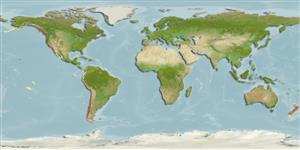
Eastern Pacific: Revillagigedo Island, southeastern Alaska (Ref. 27436) to southern California, USA; also off Baja California, Mexico.
Grootte / Gewicht / Leeftijd
Maturiteit: Lm ? range ? - ? cm
Max length : 16.0 cm TL mannelijk / geslacht onbekend; (Ref. 2850)
Korte beschrijving
Determinatiesleutels | Morfologie | Morfometrie
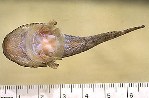
Dorsale stekels (totaal) : 0; Dorsale zachte stralen (totaal) : 13 - 16; Anale stekels: 0; Anale zachte stralen: 12 - 14. Caudal fin well rounded; pectorals short and broad, a fleshy pulp between the base of the fin and the gill opening; pelvic fins united anteriorly by a papillose membrane, the rays are flexible and support the lateral rim of a prominent adhesive disc; the disc is completed posteriorly by a broad fringed fold of skin on the lower part of the body, and is separated from the pelvic fins by a deep notch (Ref. 6885). Light olive brown to cherry red, reticulated with darker or mottled with light shades; dark radiating lines from eyes and joining the eyes through a series of reticulations; white bars between eyes and in young across back and on edge of caudal fin (Ref. 6885).
Body shape (shape guide): elongated.
Facultative air-breathing in the genus (Ref. 126274); Found in intertidal rocky areas among algae, and on kelp (often high in kelp canopy) (Ref. 2850). May remain out of water under rocks or seaweeds (Ref. 31184). Feeds on small crustaceans and mollusks (Ref. 6885). Breathes air when out of water (Ref. 31184).
Levenscyclus en paargedrag
Maturiteit | Voortplanting | Paaien | Eieren | Fecunditeit | Larven
Eschmeyer, W.N., E.S. Herald and H. Hammann, 1983. A field guide to Pacific coast fishes of North America. Boston (MA, USA): Houghton Mifflin Company. xii+336 p. (Ref. 2850)
Status op de Rode Lijst van het IUCN (Ref. 130435: Version 2025-2 (Global))
Gevaar voor de mens
Harmless
Gebruik door de mens
Visserij: commercieel; Aquarium: Publieke aquaria
Tools
Speciale rapporten
Download XML
Internetbronnen
Schattingen op basis van modellen
Gewenste temperatuur (Ref.
123201): 8.9 - 17.2, mean 10.8 °C (based on 346 cells).
Fylogenetische diversiteitsindex (Ref.
82804): PD
50 = 0.5000 [Uniqueness, from 0.5 = low to 2.0 = high].
Bayesian length-weight: a=0.00617 (0.00249 - 0.01527), b=3.15 (2.93 - 3.37), in cm total length, based on LWR estimates for this (Sub)family-body shape (Ref.
93245).
Trofisch niveau (Ref.
69278): 3.4 ±0.3 se; based on diet studies.
Weerstandsvermogen (Ref.
120179): laag, minimale populatieverdubbelingstijd 4,5-14 jaar (Annual fecundity = 382).
Kwetsbaarheid van de visserij (Ref.
59153): Low vulnerability (10 of 100).
🛈