>
Gobiesociformes (Clingfishes) >
Gobiesocidae (Clingfishes and singleslits) > Gobiesocinae
Etymology: Gobiesox: Latin, gobius = gudgeon + Esox, the old name for "pike" (Ref. 45335).
More on author: Girard.
Ambiente: milieu / zona climatica / distribuzione batimetrica / gamma di distribuzione
Ecologia
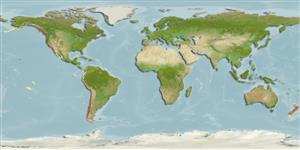
marino demersale; distribuzione batimetrica 0 - 8 m (Ref. 2850). Subtropical; 59°N -
Eastern Pacific: Revillagigedo Island, southeastern Alaska (Ref. 27436) to southern California, USA; also off Baja California, Mexico.
Dimensione / Peso / Età
Maturità: Lm ? range ? - ? cm
Max length : 16.0 cm TL maschio/sesso non determinato; (Ref. 2850)
Breve descrizione
Chiavi di identificazione | Morfologia | Morfometria
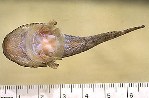
Spine dorsali (totale) : 0; Raggi dorsali molli (totale) : 13 - 16; Spine anali: 0; Raggi anali molli: 12 - 14. Caudal fin well rounded; pectorals short and broad, a fleshy pulp between the base of the fin and the gill opening; pelvic fins united anteriorly by a papillose membrane, the rays are flexible and support the lateral rim of a prominent adhesive disc; the disc is completed posteriorly by a broad fringed fold of skin on the lower part of the body, and is separated from the pelvic fins by a deep notch (Ref. 6885). Light olive brown to cherry red, reticulated with darker or mottled with light shades; dark radiating lines from eyes and joining the eyes through a series of reticulations; white bars between eyes and in young across back and on edge of caudal fin (Ref. 6885).
Body shape (shape guide): elongated.
Facultative air-breathing in the genus (Ref. 126274); Found in intertidal rocky areas among algae, and on kelp (often high in kelp canopy) (Ref. 2850). May remain out of water under rocks or seaweeds (Ref. 31184). Feeds on small crustaceans and mollusks (Ref. 6885). Breathes air when out of water (Ref. 31184).
Ciclo vitale e comportamento di accoppiamento
Maturità | Riproduzione | Deposizione | Uova | Fecondità | Larve
Eschmeyer, W.N., E.S. Herald and H. Hammann, 1983. A field guide to Pacific coast fishes of North America. Boston (MA, USA): Houghton Mifflin Company. xii+336 p. (Ref. 2850)
Stato della Lista Rossa IUCN (Ref. 130435: Version 2025-2 (Global))
Minaccia per l'uomo
Harmless
Usi umani
Pesca: commerciale; Acquario: Acquari pubblici
Strumenti
Rapporti speciali
Scarica XML
Fonti Internet
Stime basate su modelli
Temperatura preferita (Fonte Biblio.
123201): 8.9 - 17.2, mean 10.8 °C (based on 346 cells).
Indice di diversità filogenetica (Fonte Biblio.
82804): PD
50 = 0.5000 [Uniqueness, from 0.5 = low to 2.0 = high].
Bayesian length-weight: a=0.00617 (0.00249 - 0.01527), b=3.15 (2.93 - 3.37), in cm total length, based on LWR estimates for this (Sub)family-body shape (Ref.
93245).
Livello trofico (Fonte Biblio.
69278): 3.4 ±0.3 se; based on diet studies.
Resilienza (Fonte Biblio.
120179): Basso, tempo minimo di raddoppiamento della popolazione 4.5 - 14 anni (Annual fecundity = 382).
Vulnerabilità della pesca (Ref.
59153): Low vulnerability (10 of 100).
🛈