>
Gadiformes (Cods) >
Gadidae (Cods and haddocks)
Etymology: Boreogadus: Greek, boreas = north wind + Latin, gadus = a fish, cod? (Ref. 45335).
Ambiente: milieu / zona climatica / distribuzione batimetrica / gamma di distribuzione
Ecologia
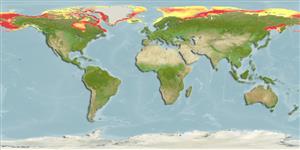
marino; salmastro demersale; oceanodromo (Ref. 12074); distribuzione batimetrica 0 - 1383 m (Ref. 58426), usually 0 - 400 m (Ref. 1371). Polar; -2°C - 8°C (Ref. 96379); 87°N - 52°N, 180°W - 180°E (Ref. 1371)
Circumpolar in the Arctic. North Atlantic: White Sea, Iceland, and southern Greenland into the Miramichi River, New Brunswick in Canada. North Pacific: Bering Sea to Cape Olyutorski, the Pribilof Islands, and Bristol Bay.
Dimensione / Peso / Età
Maturità: Lm ? range ? - ? cm
Max length : 40.0 cm TL maschio/sesso non determinato; (Ref. 1371); common length : 25.0 cm TL maschio/sesso non determinato; (Ref. 1371); Età massima riportata: 7 anni (Ref. 1371)
Breve descrizione
Chiavi di identificazione | Morfologia | Morfometria
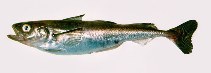
Spine dorsali (totale) : 0; Raggi dorsali molli (totale) : 42 - 57; Spine anali: 0; Raggi anali molli: 33 - 44; Vertebre: 49 - 57. Caudal fin deeply concave. Lower jaw slightly longer than upper jaw. Chin barbel very small. No lateral line pores on head. Scales small and embedded, not overlapping. Brownish along the back with many fine points; the sides and belly silvery; the fins dusky with pale margins (Ref. 1371).
Body shape (shape guide): elongated; Cross section: oval.
Occurs in coastal habitats during summer and winter (Ref. 1371). Cryopelagic or epontic, from surface down to 1383 m (Ref. 58426). In the Beaufort Sea, it may also be found in brackish lagoons and in almost fresh water in river mouths (Ref. 1371). Although associated with the occurrence of ice (White Sea), it is present in ice-free near-shore waters (Alaska) (Ref. 1371). Onshore-offshore movements are associated with spawning and movements of the ice (Ref. 27547). Feeds mostly on epibenthic mysids, also amphipods, copepods and fishes (Ref. 1371). Also caught with mid-water trawls (Ref. 1371). Utilized as fishmeal and source of oil (Ref. 1371). Euryhaline and eurythermic.
Oviparous, sexes are separate (Ref. 101194). Fish move close inshore, often in large numbers to spawn (Ref. 27547).
Cohen, D.M., T. Inada, T. Iwamoto and N. Scialabba, 1990. FAO species catalogue. Vol. 10. Gadiform fishes of the world (Order Gadiformes). An annotated and illustrated catalogue of cods, hakes, grenadiers and other gadiform fishes known to date. FAO Fish. Synop. 125(10). Rome: FAO. 442 p. (Ref. 1371)
Stato della Lista Rossa IUCN (Ref. 130435: Version 2025-2 (Global))
Minaccia per l'uomo
Harmless
Usi umani
Pesca: elevato interesse commerciale
Strumenti
Rapporti speciali
Scarica XML
Fonti Internet
Stime basate su modelli
Temperatura preferita (Fonte Biblio.
123201): -1.3 - 4, mean 0.2 °C (based on 1585 cells).
Indice di diversità filogenetica (Fonte Biblio.
82804): PD
50 = 1.0000 [Uniqueness, from 0.5 = low to 2.0 = high].
Bayesian length-weight: a=0.00457 (0.00359 - 0.00582), b=3.16 (3.09 - 3.23), in cm total length, based on LWR estimates for this species (Ref.
93245).
Livello trofico (Fonte Biblio.
69278): 3.1 ±0.1 se; based on diet studies.
Generation time: 4.9 (2.6 - 5.8) years. Estimated as median ln(3)/K based on 11
growth studies.
Resilienza (Fonte Biblio.
120179): Medio, tempo minimo di raddoppiamento della popolazione 1.4 - 4.4 anni (K=0.22; tm=2-5; Fec=30,000).
Prior r = 0.28, 95% CL = 0.19 - 0.43, Based on 2 data-limited stock assessments.
Vulnerabilità della pesca (Ref.
59153): Moderate to high vulnerability (46 of 100).
🛈
Vulnerabilità climatica (Ref.
125649): Moderate vulnerability (40 of 100).
🛈
Nutrienti (Ref.
124155): Calcium = 29.7 [14.9, 76.5] mg/100g; Iron = 0.406 [0.197, 0.920] mg/100g; Protein = 16.6 [15.0, 18.1] %; Omega3 = 0.269 [0.118, 0.607] g/100g; Selenium = 21.3 [7.3, 51.3] μg/100g; VitaminA = 9.34 [1.69, 52.12] μg/100g; Zinc = 0.575 [0.351, 0.941] mg/100g (wet weight);