>
Gadiformes (Cods) >
Gadidae (Cods and haddocks)
Etymology: Boreogadus: Greek, boreas = north wind + Latin, gadus = a fish, cod? (Ref. 45335).
Entorno: milieu / zona climática / rango de profundidad / gama de distribución
Ecología
marino; salobre demersal; oceanodromo (Ref. 12074); rango de profundidad 0 - 1383 m (Ref. 58426), usually 0 - 400 m (Ref. 1371). Polar; -2°C - 8°C (Ref. 96379); 87°N - 52°N, 180°W - 180°E (Ref. 1371)
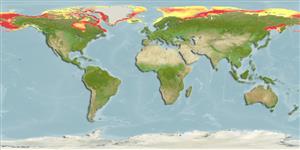
Circumpolar in the Arctic. North Atlantic: White Sea, Iceland, and southern Greenland into the Miramichi River, New Brunswick in Canada. North Pacific: Bering Sea to Cape Olyutorski, the Pribilof Islands, and Bristol Bay.
Tamaño / Peso / Edad
Madurez: Lm ? range ? - ? cm
Max length : 40.0 cm TL macho / no sexado; (Ref. 1371); common length : 25.0 cm TL macho / no sexado; (Ref. 1371); edad máxima reportada: 7 años (Ref. 1371)
Descripción breve
Claves de identificación | Morfología | Morfometría
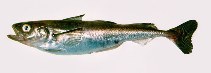
Espinas dorsales (total) : 0; Radios blandos dorsales (total) : 42 - 57; Espinas anales: 0; Radios blandos anales: 33 - 44; Vértebra: 49 - 57. Caudal fin deeply concave. Lower jaw slightly longer than upper jaw. Chin barbel very small. No lateral line pores on head. Scales small and embedded, not overlapping. Brownish along the back with many fine points; the sides and belly silvery; the fins dusky with pale margins (Ref. 1371).
Body shape (shape guide): elongated; Cross section: oval.
Occurs in coastal habitats during summer and winter (Ref. 1371). Cryopelagic or epontic, from surface down to 1383 m (Ref. 58426). In the Beaufort Sea, it may also be found in brackish lagoons and in almost fresh water in river mouths (Ref. 1371). Although associated with the occurrence of ice (White Sea), it is present in ice-free near-shore waters (Alaska) (Ref. 1371). Onshore-offshore movements are associated with spawning and movements of the ice (Ref. 27547). Feeds mostly on epibenthic mysids, also amphipods, copepods and fishes (Ref. 1371). Also caught with mid-water trawls (Ref. 1371). Utilized as fishmeal and source of oil (Ref. 1371). Euryhaline and eurythermic.
Oviparous, sexes are separate (Ref. 101194). Fish move close inshore, often in large numbers to spawn (Ref. 27547).
Cohen, D.M., T. Inada, T. Iwamoto and N. Scialabba, 1990. FAO species catalogue. Vol. 10. Gadiform fishes of the world (Order Gadiformes). An annotated and illustrated catalogue of cods, hakes, grenadiers and other gadiform fishes known to date. FAO Fish. Synop. 125(10). Rome: FAO. 442 p. (Ref. 1371)
Situación en la Lista Roja de la UICN (Ref. 130435: Version 2025-2 (Global))
Amenaza para el ser humano
Harmless
Usos humanos
Pesquerías: muy comercial
Herramientas
Informes especiales
Descargar XML
Fuentes de Internet
Estimaciones basadas en modelos
Temperatura preferida (Referencia
123201): -1.3 - 4, mean 0.2 °C (based on 1585 cells).
Índice de diversidad filogenética (Referencia
82804): PD
50 = 1.0000 [Uniqueness, from 0.5 = low to 2.0 = high].
Bayesian length-weight: a=0.00457 (0.00359 - 0.00582), b=3.16 (3.09 - 3.23), in cm total length, based on LWR estimates for this species (Ref.
93245).
Nivel trófico (Referencia
69278): 3.1 ±0.1 se; based on diet studies.
Generation time: 4.9 (2.6 - 5.8) years. Estimated as median ln(3)/K based on 11
growth studies.
Resiliencia (Referencia
120179): Medio, población duplicada en un tiempo mínimo de 1.4-4.4 años (K=0.22; tm=2-5; Fec=30,000).
Prior r = 0.28, 95% CL = 0.19 - 0.43, Based on 2 data-limited stock assessments.
Vulnerabilidad pesquera (Ref.
59153): Moderate to high vulnerability (46 of 100).
🛈
Vulnerabilidad climática (Ref.
125649): Moderate vulnerability (40 of 100).
🛈
Nutrientes (Ref.
124155): Calcium = 29.7 [14.9, 76.5] mg/100g; Iron = 0.406 [0.197, 0.920] mg/100g; Protein = 16.6 [15.0, 18.1] %; Omega3 = 0.269 [0.118, 0.607] g/100g; Selenium = 21.3 [7.3, 51.3] μg/100g; VitaminA = 9.34 [1.69, 52.12] μg/100g; Zinc = 0.575 [0.351, 0.941] mg/100g (wet weight);