>
Zeiformes (Dories) >
Zeidae (Dories)
Etymology: Zenopsis: Particle zen, derived from zao = to give life + Greek, opsis = appearance; nebulosa: nebulosus meaning dark or clouded--a dark Zeus-like fish (Ref. 4525).
More on authors: Temminck & Schlegel.
Environnement : milieu / zone climatique / profondeur / gamme de distribution
Écologie
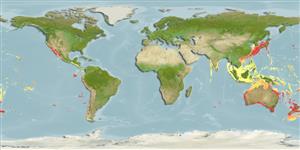
marin démersal; profondeur 30 - 800 m (Ref. 27124), usually 50 - 600 m (Ref. 27114). Deep-water; 41°N - 54°S, 72°E - 70°W
Indo-Pacific: Japan, northwest shelf of Australia to Broken Bay in New South Wales, New Zealand (Ref. 6390), and elsewhere in the region. Eastern Pacific: off central and southern California, USA (Ref. 2850); and on the seamounts of the Nazca Ridge in the Peru area (Ref. 27131).
Longueur à la première maturité / Taille / Poids / Âge
Maturité: Lm 29.0, range 25 - 40 cm
Max length : 70.0 cm TL mâle / non sexé; (Ref. 9563); poids max. publié: 3.0 kg (Ref. 27124); âge max. reporté: 45 années (Ref. 58312)
Description synthétique
Clés d'identification | Morphologie | Morphométrie
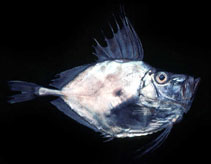
Épines dorsales (Total) : 9; Rayons mous dorsaux (Total) : 26 - 27; Épines anales: 3; Rayons mous anaux: 24 - 25.
Body shape (shape guide): short and / or deep.
Occur in deeper trawling grounds of the continental shelf and slope, close to the sea bed (Ref. 559). Generally solitary but may associate with gemfish (Ref. 132993). Caught by Japanese trawlers during winter (Ref. 559). Excellent food fish.
It is not known whether individuals undergo a single spawning or a series of spawnings over the winter months in southern Australia (Ref. 6390).
Allen, G.R. and R. Swainston, 1988. The marine fishes of north-western Australia: a field guide for anglers and divers. Western Australian Museum, Perth. 201 p. (Ref. 3132)
Statut dans la liste rouge de l'IUCN (Ref. 130435: Version 2025-2 (Global))
Menace pour l'homme
Harmless
Utilisations par l'homme
Pêcheries: commercial
Outils
Articles particuliers
Télécharger en XML
Sources Internet
Estimations basées sur des modèles
Température préférée (Réf.
123201): 7.1 - 23.8, mean 14.5 °C (based on 1184 cells).
Indice de diversité phylogénétique (Réf.
82804): PD
50 = 0.5781 [Uniqueness, from 0.5 = low to 2.0 = high].
Bayesian length-weight: a=0.01622 (0.00894 - 0.02943), b=2.93 (2.76 - 3.10), in cm total length, based on LWR estimates for this species & (Sub)family-body (Ref.
93245).
Niveau trophique (Réf.
69278): 4.4 ±0.72 se; based on food items.
Generation time: 16.5 ( na - na) years. Estimated as median ln(3)/K based on 2
growth studies.
Résilience (Réf.
120179): Très faible, temps minimum de doublement de population supérieur à 14 ans (K=0.20; tm=4-7; tmax=45; Fec=52,000).
Prior r = 0.49, 95% CL = 0.32 - 0.74, Based on 1 data-limited stock assessment.
Vulnérabilité de la pêche (Ref.
59153): High to very high vulnerability (69 of 100).
🛈
Vulnérabilité climatique (Ref.
125649): Low vulnerability (25 of 100).
🛈
Nutriments (Ref.
124155): Calcium = 12.1 [6.5, 26.4] mg/100g; Iron = 0.32 [0.13, 0.67] mg/100g; Protein = 17.5 [14.5, 20.4] %; Omega3 = 0.349 [0.162, 0.733] g/100g; Selenium = 22 [9, 55] μg/100g; VitaminA = 16.8 [3.0, 99.8] μg/100g; Zinc = 0.281 [0.180, 0.446] mg/100g (wet weight);