>
Gadiformes (Cods) >
Merlucciidae (Merluccid hakes)
Etymology: Merluccius: Latin, mar, maris = the sea + Latin, lucius = pike (Ref. 45335).
More on author: Ayres.
पर्यावरण: पर्यावरण / जलवायु क्षेत्र / गहराई सीमा / वितरण सीमा
पारिस्थितिकी
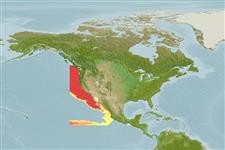
समुद्री; खारा pelagic-neritic; गहराई सीमा 0 - 1000 m (Ref. 9316), usually ? - 229 m (Ref. 2850). Temperate; 51°N - 15°N, 130°W - 77°W (Ref. 58452)
Eastern Pacific: northern Vancouver Island, Canada to northern part of the Gulf of California. A record from the Gulf of Alaska is doubtful.
प्रथम परिपक्वता पर लंबाई / आकार / वज़न / आयु
परिपक्व अवधि: Lm 37.0, range 34 - 40 cm
Max length : 83.0 cm TL पुल्लिंग / अलिंग; (Ref. 127973); 105.0 cm TL (female); common length : 60.0 cm TL पुल्लिंग / अलिंग; (Ref. 1371); अधिकतम प्रकाशित वज़न: 4.2 kg (Ref. 127973); अधिकतम प्रकाशित वज़न: 4.2 kg; अधिकतम सूचित उम्र: 16 वर्षो (Ref. 56527)
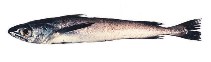
पृष्ठीय रीढ़ (सम्पूर्ण) : 1; पृष्ठीय सौफट रेज़ (सम्पूर्ण) : 48 - 56; गुदा कांटा: 0; ऐनल सौफट रेज़: 40 - 43. Head rather short. Pectoral fin tips usually reaching to or beyond the origin of anal fin. Caudal fin always concave. Color silvery on back grading to whitish ventrally.
Body shape (shape guide): elongated; Cross section: oval.
Inhabit oceanic and coastal areas, but mainly on the continental shelf (Ref. 1371). Although often classified as demersal, the distribution and behavior suggest a largely pelagic existence (Ref. 1371). Adults live in large schools in waters overlying the continental shelf and slope except during the spawning season when they are found several hundred miles seaward (Ref. 1371). A nocturnal feeder (Ref. 6885) that feed on a variety of fishes and invertebrates (Ref. 1371). Important prey for sea lions and small cetaceans (Ref. 2850); also prey of dogfish (Ref. 11384).
Cohen, D.M., T. Inada, T. Iwamoto and N. Scialabba, 1990. FAO species catalogue. Vol. 10. Gadiform fishes of the world (Order Gadiformes). An annotated and illustrated catalogue of cods, hakes, grenadiers and other gadiform fishes known to date. FAO Fish. Synop. 125(10). Rome: FAO. 442 p. (Ref. 1371)
आईयूसीएन रेड लिस्ट स्थिति (Ref. 130435: Version 2025-2 (Global))
मनुष्यों के लिए ख़तरा
Harmless
मानव उपयोग
मात्स्यिकी: उच्च वाणिज्य; आखेट मत्स्य: हां
साधन
विशेष रिपोर्ट
XML डाउनलोड करें
इंटरनेट स्रोत
मॉडल पर आधारित अनुमान
पसंदीदा तापमान (संदर्भ
123201): 7 - 12.6, mean 8.6 °C (based on 23 cells).
जातिवृति विविधता सूचकांक (संदर्भ
82804): PD
50 = 0.5000 [Uniqueness, from 0.5 = low to 2.0 = high].
Bayesian length-weight: a=0.00468 (0.00386 - 0.00566), b=3.09 (3.04 - 3.14), in cm total length, based on LWR estimates for this species (Ref.
93245).
ट्रॉफिक स्तर (संदर्भ
69278): 4.4 ±0.0 se; based on diet studies.
लौटाव (संदर्भ
120179): माध्यम, न्यूनतम जनसंख्या दुगनी होने का समय 1.4 - 4.4 वर्ष। (tmax=17; tm=4; also Musick et al. 2000 (Ref.
36717)).
Prior r = 0.52, 95% CL = 0.35 - 0.79, Based on 4 full stock assessments.
मछली पकड़ने की भेद्यता (Ref.
59153): Moderate vulnerability (43 of 100).
🛈
जलवायु भेद्यता (Ref.
125649): Moderate to high vulnerability (53 of 100).
🛈
पोषक तत्व (Ref.
124155): Calcium = 10.2 [5.9, 23.4] mg/100g; Iron = 0.258 [0.108, 0.535] mg/100g; Protein = 18.1 [17.0, 19.4] %; Omega3 = 0.307 [0.183, 0.505] g/100g; Selenium = 21.6 [9.0, 51.7] μg/100g; VitaminA = 17.2 [5.7, 53.3] μg/100g; Zinc = 0.357 [0.261, 0.491] mg/100g (wet weight); based on
nutrient studies.