Klassifizierung / Names
Namen | Synonyme | Catalog of Fishes(Gattung, Arten) | ITIS | CoL | WoRMS | Cloffa
>
Perciformes/Percoidei (Perchs) >
Percidae (Perches) > Etheostomatinae
Etymology: Etheostoma: Greek, etheo = to strain + Greek, stoma = mouth; Rafinesque said "various mouths", but Jordan and Evermann suggest the name might have been intended as "Heterostoma (Ref. 45335).
Eponymy: Julia Ringold Hughes (1849–1916) was the wife of ichthyologist Dr Charles Henry Gilbert (1859–1928). (Also see Gilbert, CH). (Ref. 128868), visit book page.
More on author: Meek.
Umwelt: Milieu / Klimazone / Tiefenbereich / Verbreitungsgebiet
Ökologie
; süßwasser benthopelagisch. Subtropical; 38°N - 33°N
North America: found only in White River drainage (excluding Black River system) in southern Missouri and northern Arkansas, USA.
Länge bei der ersten Reifung / Größe / Gewicht / Alter
Geschlechtsreife: Lm 3.2 range ? - ? cm
Max length : 7.8 cm TL Männchen/unbestimmt; (Ref. 5723); common length : 4.8 cm TL Männchen/unbestimmt; (Ref. 12193); max. veröff. Alter: 3.00 Jahre (Ref. 7043)
Rückenflossenstacheln (insgesamt) : 11 - 12; Rückenflossenweichstrahlen (insgesamt) : 11 - 12; Afterflossenstacheln: 2; Afterflossenweichstrahlen: 7 - 8; Wirbelzahl: 35 - 36.
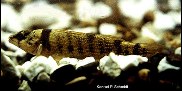
Body shape (shape guide): elongated.
Occur in clear, fast, rocky riffles of creeks and small to medium rivers (Ref. 5723). Spawn in batches (Ref. 36980). Distinct pairing during breeding (Ref. 36980).
Breeding pairs were observed on gravel patches behind rocks in 30-60 cm of water. The following account of mating behaviour comes from (Ref. 36980): 'In a typical behavior pattern, 5-10 males were observed following a gravid female..Once the female had selected a suitable spawning site, she would dig head first into the gravel with violent thrashing movements. After two or three attempts, females usually became half buried in the gravel with only head and pectoral fins exposed. During this activity attending males began making rapid darting movements around the female. The attending males moved closer to the buried female until one male, usually the largest, positioned himself beside or over her. Occasionally an even larger male would enter an area and replace the attendant male. After a male had remained with a buried female for a few minutes, he began to aggressively defend a territory. Other males that came within about 20 cm of the female were quickly chased away. In the absence of other males, the attendant male began courtship behavior by darting rapidly around the female, nudging her with his snout and perching along side or on top of her. Courtship lasted up to 30 min. Then the female began a series of rapid quivering movements followed by, or concurrent with, trembling movements by the male. It was assumed that the rapid vibrating movements of the female and male, lasting about 5 sec., indicated deposition of eggs and release of sperm. A female remained buried in the same spot during a series of 3-5 quiverings over a period of nearly 5 min. About 10 min after spawning, both fish moved away from the nest and egg guarding was not observed by either sex.' Eggs are buried under small gravel and pebbles (Ref. 36980).
Page, L.M. and B.M. Burr, 1991. A field guide to freshwater fishes of North America north of Mexico. Houghton Mifflin Company, Boston. 432 p. (Ref. 5723)
IUCN Rote Liste Status (Ref. 130435: Version 2025-2 (Global))
Bedrohung für Menschen
Harmless
Nutzung durch Menschen
Tools
Zusatzinformationen
Download XML
Internet Quellen
Schätzungen auf der Grundlage von Modellen
Phylogenetischer Diversitätsindex (Ref.
82804): PD
50 = 0.5000 [Uniqueness, from 0.5 = low to 2.0 = high].
Bayesian length-weight: a=0.00912 (0.00558 - 0.01492), b=3.17 (3.03 - 3.31), in cm total length, based on LWR estimates for this species & Genus-body shape (Ref.
93245).
Trophische Ebene (Ref.
69278): 3.3 ±0.5 se; based on size and trophs of closest relatives
Widerstandsfähigkeit (Ref.
120179): hoch, Verdopplung der Population dauert weniger als 15 Monate. (K=0.40-0.99; tm=1; tmax=3; Fec=800).
Anfälligkeit der Fischerei (Ref.
59153): Low vulnerability (14 of 100).
🛈