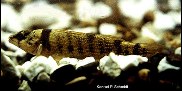
>
Perciformes/Percoidei (Perchs) >
Percidae (Perches) > Etheostomatinae
Etymology: Etheostoma: Greek, etheo = to strain + Greek, stoma = mouth; Rafinesque said "various mouths", but Jordan and Evermann suggest the name might have been intended as "Heterostoma (Ref. 45335).
Eponymy: Julia Ringold Hughes (1849–1916) was the wife of ichthyologist Dr Charles Henry Gilbert (1859–1928). (Also see Gilbert, CH). (Ref. 128868), visit book page.
More on author: Meek.
Môi trường: môi trường / vùng khí hậu / Mức độ sâu / phạm vi phân phối
Sinh thái học
; nước ngọt sống nổi và đáy. Subtropical; 38°N - 33°N
North America: found only in White River drainage (excluding Black River system) in southern Missouri and northern Arkansas, USA.
Chiều dài lúc trưởng thành đầu tiên / Bộ gần gũi / Khối lượng (Trọng lượng) / Tuổi
Chín muồi sinh dục: Lm 3.2 range ? - ? cm
Max length : 7.8 cm TL con đực/không giới tính; (Ref. 5723); common length : 4.8 cm TL con đực/không giới tính; (Ref. 12193); Tuổi cực đại được báo cáo: 3.00 các năm (Ref. 7043)
Các tia vây lưng cứng (tổng cộng) : 11 - 12; Các vây lưng mềm (tổng cộng) : 11 - 12; Tia cứng vây hậu môn: 2; Tia mềm vây hậu môn: 7 - 8; Động vật có xương sống: 35 - 36.
Body shape (shape guide): elongated.
Occur in clear, fast, rocky riffles of creeks and small to medium rivers (Ref. 5723). Spawn in batches (Ref. 36980). Distinct pairing during breeding (Ref. 36980).
Breeding pairs were observed on gravel patches behind rocks in 30-60 cm of water. The following account of mating behaviour comes from (Ref. 36980): 'In a typical behavior pattern, 5-10 males were observed following a gravid female..Once the female had selected a suitable spawning site, she would dig head first into the gravel with violent thrashing movements. After two or three attempts, females usually became half buried in the gravel with only head and pectoral fins exposed. During this activity attending males began making rapid darting movements around the female. The attending males moved closer to the buried female until one male, usually the largest, positioned himself beside or over her. Occasionally an even larger male would enter an area and replace the attendant male. After a male had remained with a buried female for a few minutes, he began to aggressively defend a territory. Other males that came within about 20 cm of the female were quickly chased away. In the absence of other males, the attendant male began courtship behavior by darting rapidly around the female, nudging her with his snout and perching along side or on top of her. Courtship lasted up to 30 min. Then the female began a series of rapid quivering movements followed by, or concurrent with, trembling movements by the male. It was assumed that the rapid vibrating movements of the female and male, lasting about 5 sec., indicated deposition of eggs and release of sperm. A female remained buried in the same spot during a series of 3-5 quiverings over a period of nearly 5 min. About 10 min after spawning, both fish moved away from the nest and egg guarding was not observed by either sex.' Eggs are buried under small gravel and pebbles (Ref. 36980).
Page, L.M. and B.M. Burr, 1991. A field guide to freshwater fishes of North America north of Mexico. Houghton Mifflin Company, Boston. 432 p. (Ref. 5723)
Tình trạng Sách đỏ IUCN (Ref. 130435: Version 2025-2 (Global))
Mối đe dọa đối với con người
Harmless
Sử dụng của con người
Các công cụ
Báo cáo đặc biệt
Tải xuống XML
Các nguồn internet
Ước tính dựa trên mô hình
Chỉ số đa dạng phát sinh loài (Tài liệu tham khảo
82804): PD
50 = 0.5000 [Uniqueness, from 0.5 = low to 2.0 = high].
Bayesian length-weight: a=0.00912 (0.00558 - 0.01492), b=3.17 (3.03 - 3.31), in cm total length, based on LWR estimates for this species & Genus-body shape (Ref.
93245).
Mức dinh dưỡng (Tài liệu tham khảo
69278): 3.3 ±0.5 se; based on size and trophs of closest relatives
Thích nghi nhanh (Tài liệu tham khảo
120179): Chiêù cao, thời gian nhân đôi của chủng quần tối thiểu là dưới 15 tháng (K=0.40-0.99; tm=1; tmax=3; Fec=800).
Sự dễ bị tổn thương của nghề đánh cá (Ref.
59153): Low vulnerability (14 of 100).
🛈