Ambiente: milieu / zona climática / intervalo de profundidade / gama de distribuição
Ecologia
marinhas associadas(os) a recifes; intervalo de profundidade 50 - ? m (Ref. 89707). Subtropical; 32°N - 10°S, 117°W - 77°W (Ref. 5222)
Eastern Pacific: southern California in the USA to Peru, including Revillagigedo, Clipperton and the Galapagos islands. It is the most abundant small grouper in the northern Gulf of California.
Tamanho / Peso / Idade
Maturidade: Lm ? range ? - ? cm
Max length : 114 cm TL macho/indeterminado; (Ref. 89707); peso máx. Publicado: 22.3 kg (Ref. 40637)
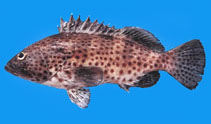
Espinhos dorsais (total) : 10; Raios dorsais moles (total) : 16 - 18; Espinhos anais: 3; Raios anais moles: 8. Distinguished by the following characteristics: generally pale reddish brown covered with numerous dark brown spots; 5 faint oblique dark bars on body; body depth less than head length, 2.6-3.0 times in SL; head length 2.3-2.5 times in SL; shallow notch above the angle of preopercle, serrae at angle slightly enlarged; slightly convex upper edge of operculum; subequal posterior and anterior nostrils; pelvic fins shorter than pectoral fins and their origin below or behind lower end of pectoral fin base; rounded caudal fin; ctenoid midlateral-body scales, with numerous auxiliary scales (Ref. 089707).
Body shape (shape guide): fusiform / normal; Cross section: compressed.
Abundant in patch reefs where it is readily caught by anglers. Inhabits depths of at least 50 m (Ref. 089707). Feeds mainly on crustaceans and fishes on rocky and sandy bottoms. During winter, it moves closer to the shore where it feeds heavily on swarms of pelagic red crab Pleuroncodes planipes.
Ciclo de vida e comportamento de acasalamento
Maturidade | Reprodução | Desova | Ovos | Fecundidade | Larvas
Heemstra, P.C. and J.E. Randall, 1993. FAO Species Catalogue. Vol. 16. Groupers of the world (family Serranidae, subfamily Epinephelinae). An annotated and illustrated catalogue of the grouper, rockcod, hind, coral grouper and lyretail species known to date. Rome: FAO. FAO Fish. Synop. 125(16):382 p. (Ref. 5222)
Categoria na Lista Vermelha da IUCN (Ref. 130435: Version 2025-2 (Global))
Ameaça para o homem
Harmless
Utilização humana
Pescarias: pouco comercial; peixe desportivo: sim
Ferramentas
Relatórios especiais
Descarregue XML
Fontes da internet
Estimativas baseadas em modelos
Índice de diversidade filogenética (Ref.
82804): PD
50 = 0.5000 [Uniqueness, from 0.5 = low to 2.0 = high].
Bayesian length-weight: a=0.01148 (0.00555 - 0.02374), b=3.04 (2.87 - 3.21), in cm total length, based on LWR estimates for this Genus-body shape (Ref.
93245).
Nível Trófico (Ref.
69278): 3.8 ±0.64 se; based on food items.
Resiliência (Ref.
120179): Médio, tempo mínimo de duplicação da população 1,4 - 4,4 anos (Assuming tm=2-4).
Vulnerabilidade da pesca (Ref.
59153): High to very high vulnerability (68 of 100).
🛈
Vulnerabilidade climática (Ref.
125649): Very high vulnerability (89 of 100).
🛈
Nutrientes (Ref.
124155): Calcium = 10.5 [3.8, 23.1] mg/100g; Iron = 0.403 [0.204, 0.850] mg/100g; Protein = 19.2 [17.6, 20.7] %; Omega3 = 0.172 [0.094, 0.319] g/100g; Selenium = 24.6 [11.9, 50.8] μg/100g; VitaminA = 76.9 [18.4, 304.3] μg/100g; Zinc = 0.739 [0.489, 1.109] mg/100g (wet weight);