>
Perciformes/Zoarcoidei (Eelpouts and pricklebacks) >
Stichaeidae (Pricklebacks) > Xiphisterinae
Etymology: Anoplarchus: Greek, ana = up + Greek, oplon = shield + Greek, archos = anus (Ref. 45335).
More on author: Gill.
Περιβάλλον: περιβάλλον / κλιματική ζώνη / εύρος βάθους / εύρος διανομής
Οικολογία
Θαλασσινό(ά) βενθικό(ς); εύρος βάθους 1 - 30 m (Ref. 2850). Temperate; 66°N - 32°N
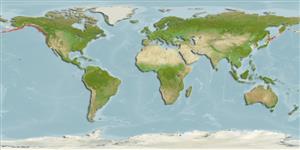
Eastern Pacific: Pribilof Islands, Alaska to Santa Rosa Island and Trinidad Bay, southern California, USA.
Μέγεθος / Βάρος / Ηλικία
Γεννητική Ωρίμανση: Lm ? range ? - ? cm
Max length : 20.0 cm TL αρσενικό/απροσδιόριστο; (Ref. 2850)
Σύντομη περιγραφή
Κλείδες προσδιορισμού | Μορφολογία | Μορφομετρία
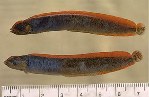
Ραχιαίες άκανθες (συνολικά) : 55 - 58; Μαλακές ραχιαίες ακτίνες (συνολικά) : 0; Εδρικές άκανθες: 0; Μαλακές εδρικές ακτίνες: 39 - 40; Σπόνδυλοι: 58 - 61. Caudal with convex outer margin (Ref. 6885). Color very variable- may be light to dark gray with olivaceous overtones, brown to dark brown with or without reddish overtones, or purple to almost black. Females are less varied in color, but show more pattern, usually having green grayish backgrounds with brownish reticulations, or dark brownish backgrounds with subdued reticulation. Belly pale. In the males, the cockscomb and under surface of head are pale, rather yellowish, and without speckling. In the female, the head is more speckled and mottled. There is a gray bar across the base of the caudal peduncle. At breeding season, the male develops bright orange colors on its anal and pectoral fins, and reddish on the caudal and dorsal fins (Ref. 6885).
Facultative air-breathing (Ref. 126274); Usually found in intertidal areas under rocks (Ref. 2850). May remain out of water under rocks or seaweed (Ref. 31184). Green algae is an important food item but may also feed on polychaete worms, crustaceans and mollusks (Ref. 6885). Breathes air (Ref. 31184) and can remain out of water for 15-25 hours if kept moist (Ref. 51276).
Spawning individuals are territorial. The female guards the egg mass deposited between rocks and shells by bending her body over the eggs. She fans the eggs by moving the posterior part of her body (Ref. 6885). In the aquarium, males mate with several females (Ref. 39998).
Eschmeyer, W.N., E.S. Herald and H. Hammann, 1983. A field guide to Pacific coast fishes of North America. Boston (MA, USA): Houghton Mifflin Company. xii+336 p. (Ref. 2850)
Κατάσταση Κόκκινου Καταλόγου IUCN (Ref. 130435: Version 2025-2 (Global))
Απειλή για τον άνθρωπο
Harmless
Ανθρώπινες χρήσεις
Εργαλεία
Ειδικές εκθέσεις
Λήψη XML
Διαδικτυακές πηγές
Εκτιμήσεις βάσει μοντέλων
Προτιμώμενη θερμοκρασία (Αναφ.
123201): 5.9 - 13.4, mean 8.9 °C (based on 428 cells).
Δείκτης φυλογενετικής ποικιλότητας (Αναφ.
82804): PD
50 = 0.7500 [Uniqueness, from 0.5 = low to 2.0 = high].
Bayesian length-weight: a=0.00389 (0.00180 - 0.00842), b=3.12 (2.94 - 3.30), in cm total length, based on all LWR estimates for this body shape (Ref.
93245).
Τροφικό Επίπεδο (Αναφ.
69278): 2.9 ±0.1 se; based on diet studies.
Ελαστικότητα (Αναφ.
120179): Μεσαίο(α), ελάχιστος χρόνος για διπλασιασμό πληθυσμού 1,4 - 4,4 έτη (tm=2-3; Fec=2,700).
Ευπάθεια στην αλιεία (Ref.
59153): Low vulnerability (10 of 100).
🛈