>
Perciformes/Zoarcoidei (Eelpouts and pricklebacks) >
Stichaeidae (Pricklebacks) > Xiphisterinae
Etymology: Anoplarchus: Greek, ana = up + Greek, oplon = shield + Greek, archos = anus (Ref. 45335).
More on author: Gill.
Môi trường: môi trường / vùng khí hậu / Mức độ sâu / phạm vi phân phối
Sinh thái học
biển gần đáy; mức độ sâu 1 - 30 m (Ref. 2850). Temperate; 66°N - 32°N
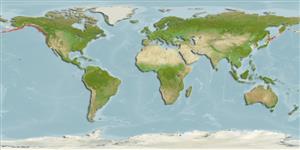
Eastern Pacific: Pribilof Islands, Alaska to Santa Rosa Island and Trinidad Bay, southern California, USA.
Bộ gần gũi / Khối lượng (Trọng lượng) / Tuổi
Chín muồi sinh dục: Lm ? range ? - ? cm
Max length : 20.0 cm TL con đực/không giới tính; (Ref. 2850)
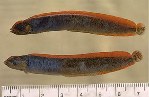
Các tia vây lưng cứng (tổng cộng) : 55 - 58; Các vây lưng mềm (tổng cộng) : 0; Tia cứng vây hậu môn: 0; Tia mềm vây hậu môn: 39 - 40; Động vật có xương sống: 58 - 61. Caudal with convex outer margin (Ref. 6885). Color very variable- may be light to dark gray with olivaceous overtones, brown to dark brown with or without reddish overtones, or purple to almost black. Females are less varied in color, but show more pattern, usually having green grayish backgrounds with brownish reticulations, or dark brownish backgrounds with subdued reticulation. Belly pale. In the males, the cockscomb and under surface of head are pale, rather yellowish, and without speckling. In the female, the head is more speckled and mottled. There is a gray bar across the base of the caudal peduncle. At breeding season, the male develops bright orange colors on its anal and pectoral fins, and reddish on the caudal and dorsal fins (Ref. 6885).
Facultative air-breathing (Ref. 126274); Usually found in intertidal areas under rocks (Ref. 2850). May remain out of water under rocks or seaweed (Ref. 31184). Green algae is an important food item but may also feed on polychaete worms, crustaceans and mollusks (Ref. 6885). Breathes air (Ref. 31184) and can remain out of water for 15-25 hours if kept moist (Ref. 51276).
Spawning individuals are territorial. The female guards the egg mass deposited between rocks and shells by bending her body over the eggs. She fans the eggs by moving the posterior part of her body (Ref. 6885). In the aquarium, males mate with several females (Ref. 39998).
Eschmeyer, W.N., E.S. Herald and H. Hammann, 1983. A field guide to Pacific coast fishes of North America. Boston (MA, USA): Houghton Mifflin Company. xii+336 p. (Ref. 2850)
Tình trạng Sách đỏ IUCN (Ref. 130435: Version 2025-2 (Global))
Mối đe dọa đối với con người
Harmless
Sử dụng của con người
Các công cụ
Báo cáo đặc biệt
Tải xuống XML
Các nguồn internet
Ước tính dựa trên mô hình
Nhiệt độ ưa thích (Tài liệu tham khảo
123201): 5.9 - 13.4, mean 8.9 °C (based on 428 cells).
Chỉ số đa dạng phát sinh loài (Tài liệu tham khảo
82804): PD
50 = 0.7500 [Uniqueness, from 0.5 = low to 2.0 = high].
Bayesian length-weight: a=0.00389 (0.00180 - 0.00842), b=3.12 (2.94 - 3.30), in cm total length, based on all LWR estimates for this body shape (Ref.
93245).
Mức dinh dưỡng (Tài liệu tham khảo
69278): 2.9 ±0.1 se; based on diet studies.
Thích nghi nhanh (Tài liệu tham khảo
120179): Trung bình, thời gian nhân đôi của chủng quần tối thiểu là 1.4 - 4.4 năm (tm=2-3; Fec=2,700).
Sự dễ bị tổn thương của nghề đánh cá (Ref.
59153): Low vulnerability (10 of 100).
🛈