Ikan bertulang rawan (sharks and rays) >
Myliobatiformes (Stingrays) >
Myliobatidae (Eagle and manta rays)
Etymology: Myliobatis: Greek, mylo = mill + Greek, + Greek, batis,-idos = a ray (Raja sp.) (Ref. 45335).
More on author: Linnaeus.
Lingkungan: lingkungan / zona iklim / kisaran kedalaman / jangkauan distribusi
Ekologi
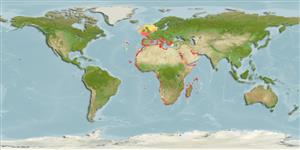
laut; payau bentopelagis; kisaran kedalaman 1 - 300 m (Ref. 4440). Subtropical; 60°N - 36°S, 32°W - 58°E
Eastern Atlantic: Madeira, Morocco and the Canary Islands north to the western coasts of Ireland and British Isles and the southwestern North Sea, south to Natal, South Africa (western Indian Ocean); throughout the Mediterranean.
Panjang pada saat jatuh tempo pertama / Ukuran / Berat / umur
Kematangan: Lm ?, range 60 - ? cm
Max length : 183 cm WD jantan/; (Ref. 4440); Berat maksimum terpublikasi: 14.5 kg (Ref. 40637)
deskripsi pendek
Kunci identifiaksi (pengenalan) | Morfologi | Morfometrik
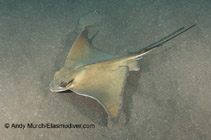
A plain eagleray with a short, rounded snout; disc with broadly angular corners, and upper or lower jaw usually with 7 rows of plate-like teeth (Ref. 5578). Brown or blackish dorsally, white ventrally (Ref. 5578). No caudal fin (Ref. 5578).
Body shape (shape guide): other.
Found in shallow lagoons (Ref. 3965), bays and estuaries; also offshore down to at least 95 m (Ref. 5578). Often found in groups (Ref. 5578). Feeds on benthic crustaceans, mollusks and fish. Ovoviviparous (Ref. 50449). Gestation period of 6-8 months, the females give birth to 3-7 young (Ref. 35388). Caught by shore and ski-boat anglers, usually released after capture (Ref. 5578). Flesh is highly esteemed (Ref. 3965).
Exhibit ovoviparity (aplacental viviparity), with embryos feeding initially on yolk, then receiving additional nourishment from the mother by indirect absorption of uterine fluid enriched with mucus, fat or protein through specialised structures (Ref. 50449).
McEachran, J.D. and B. Séret, 1990. Myliobatididae. p. 67-70. In J.C. Quero, J.C. Hureau, C. Karrer, A. Post and L. Saldanha (eds.) Check-list of the fishes of the eastern tropical Atlantic (CLOFETA). JNICT, Lisbon; SEI, Paris; and UNESCO, Paris. Vol. 1. (Ref. 4440)
Status IUCN Red List (Ref. 130435: Version 2025-2 (Global))
ancaman kepada manusia
Harmless
penggunaan manusia
Perikanan: nilai komersial kecil; Ikan buruan: ya
Alat, peralatan
laporan khas
muat turun XML
Sumber internet
Estimasi berdasarkan model
Suhu yang disukai (Acuan
123201): 11.7 - 19.8, mean 15.2 °C (based on 318 cells).
Indeks keanekaragaman filogenetik (Acuan
82804): PD
50 = 0.5002 [Uniqueness, from 0.5 = low to 2.0 = high].
Bayesian length-weight: a=0.00389 (0.00124 - 0.01219), b=3.08 (2.83 - 3.33), in cm total length, based on LWR estimates for this (Sub)family-body shape (Ref.
93245).
Tingkat Trofik (Acuan
69278): 3.6 ±0.54 se; based on food items.
Daya lenting (Acuan
120179): sangat rendah, Waktu penggandaan populasi minimum lebih dari 14 tahun (Fec=3).
Kerentanan Penangkapan Ikan (Ref.
59153): Very high vulnerability (83 of 100).
🛈
Kerentanan Iklim (Ref.
125649): Moderate to high vulnerability (47 of 100).
🛈
Nutrisi (Ref.
124155): Calcium = 6.54 [0.80, 118.48] mg/100g; Iron = 0.508 [0.046, 6.020] mg/100g; Protein = 20.4 [15.1, 25.6] %; Omega3 = 0.205 [0.068, 0.558] g/100g; Selenium = 36.1 [6.7, 193.9] μg/100g; VitaminA = 3.95 [0.36, 41.63] μg/100g; Zinc = 0.492 [0.030, 5.489] mg/100g (wet weight);