Klassifizierung / Names
Namen | Synonyme | Catalog of Fishes(Gattung, Arten) | ITIS | CoL | WoRMS | Cloffa
>
Ovalentaria/misc (Various families in series Ovalentaria) >
Pomacentridae (Damselfishes) > Microspathodontinae
Etymology: Plectroglyphidodon: Greek,plektron = anything to strike with, spur + Greek, glyphis = carved + Greek, odous = teeth (Ref. 45335).
Eponymy: HMAS ‘Gascoyne’, is a vessel from which the type was collected during a survey of islands in the Coral Sea. (Ref. 128868), visit book page.
More on author: Whitley.
Umwelt: Milieu / Klimazone / Tiefenbereich / Verbreitungsgebiet
Ökologie
seewasser riff-verbunden; standorttreu; tiefenbereich 1 - 30 m (Ref. 9710). Subtropical; 10°S - 50°S
Western Pacific: endemic to the southern Coral Sea-northern Tasman Sea region; known in Australia, Norfolk Islands, and New Caledonia, New Zealand.
Größe / Gewicht / Alter
Geschlechtsreife: Lm ? range ? - ? cm
Max length : 15.0 cm TL Männchen/unbestimmt; (Ref. 9710)
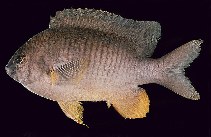
Rückenflossenstacheln (insgesamt) : 14; Rückenflossenweichstrahlen (insgesamt) : 14 - 16; Afterflossenstacheln: 2; Afterflossenweichstrahlen: 13 - 14. Body and head color primarily brown, yellow-orange on ventral portion. A blue streak runs from the snout to the suborbital. Blue or purplish spots are on opercular series. Each scale with dark brown streak near its margin, appearing as series of narrow transverse bands. The dorsal is fin brown, posteriormost is somewhat translucent. The caudal fin is tan to brown, outermost part translucent to yellowish. The anal and pelvic fins yellow to orange. The pectorals are transparent with suffusion of yellow with a small dark spot superiorly at its base.
Body shape (shape guide): short and / or deep; Cross section: oval.
Adults inhabit coral and rocky reefs (Ref. 9710). Oviparous, distinct pairing during breeding (Ref. 205). Eggs are demersal and adhere to the substrate (Ref. 205). Males guard and aerate the eggs (Ref. 205).
Lebenszyklus und Paarungsverhalten
Geschlechtsreife | Fortpflanzung | Ablaichen | Eier | Fruchtbarkeit | Larven
Oviparous, distinct pairing during breeding (Ref. 205). Eggs are demersal and adhere to the substrate (Ref. 205). Males guard and aerate the eggs (Ref. 205).
Allen, G.R. and A.R. Emery, 1985. A review of the Pomacentrid fishes of the genus Stegastes from the Indo-Pacific, with descriptions of two new species. Indo-Pac. Fish. (3):31. (Ref. 510)
IUCN Rote Liste Status (Ref. 130435: Version 2025-2 (Global))
Bedrohung für Menschen
Harmless
Nutzung durch Menschen
Tools
Zusatzinformationen
Download XML
Internet Quellen
Schätzungen auf der Grundlage von Modellen
Bevorzugte Temperatur (Ref.
123201): 21.6 - 27.1, mean 25.6 °C (based on 300 cells).
Phylogenetischer Diversitätsindex (Ref.
82804): PD
50 = 0.5000 [Uniqueness, from 0.5 = low to 2.0 = high].
Bayesian length-weight: a=0.01995 (0.00910 - 0.04376), b=2.99 (2.80 - 3.18), in cm total length, based on LWR estimates for this (Sub)family-body shape (Ref.
93245).
Widerstandsfähigkeit (Ref.
120179): hoch, Verdopplung der Population dauert weniger als 15 Monate. (Preliminary K or Fecundity.).
Anfälligkeit der Fischerei (Ref.
59153): Low vulnerability (10 of 100).
🛈
Nährstoffe (Ref.
124155): Calcium = 60.1 [25.3, 105.9] mg/100g; Iron = 0.697 [0.407, 1.265] mg/100g; Protein = 18.9 [17.7, 20.1] %; Omega3 = 0.163 [0.089, 0.289] g/100g; Selenium = 12.2 [5.6, 26.1] μg/100g; VitaminA = 47.3 [11.2, 186.6] μg/100g; Zinc = 1.11 [0.69, 1.76] mg/100g (wet weight);