>
Ovalentaria/misc (Various families in series Ovalentaria) >
Pomacentridae (Damselfishes) > Microspathodontinae
Etymology: Plectroglyphidodon: Greek,plektron = anything to strike with, spur + Greek, glyphis = carved + Greek, odous = teeth (Ref. 45335).
Eponymy: HMAS ‘Gascoyne’, is a vessel from which the type was collected during a survey of islands in the Coral Sea. (Ref. 128868), visit book page.
More on author: Whitley.
Ambiente: milieu / zona climática / intervalo de profundidade / gama de distribuição
Ecologia
marinhas associadas(os) a recifes; não migratória; intervalo de profundidade 1 - 30 m (Ref. 9710). Subtropical; 10°S - 50°S
Western Pacific: endemic to the southern Coral Sea-northern Tasman Sea region; known in Australia, Norfolk Islands, and New Caledonia, New Zealand.
Tamanho / Peso / Idade
Maturidade: Lm ? range ? - ? cm
Max length : 15.0 cm TL macho/indeterminado; (Ref. 9710)
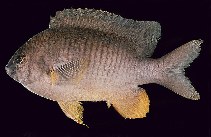
Espinhos dorsais (total) : 14; Raios dorsais moles (total) : 14 - 16; Espinhos anais: 2; Raios anais moles: 13 - 14. Body and head color primarily brown, yellow-orange on ventral portion. A blue streak runs from the snout to the suborbital. Blue or purplish spots are on opercular series. Each scale with dark brown streak near its margin, appearing as series of narrow transverse bands. The dorsal is fin brown, posteriormost is somewhat translucent. The caudal fin is tan to brown, outermost part translucent to yellowish. The anal and pelvic fins yellow to orange. The pectorals are transparent with suffusion of yellow with a small dark spot superiorly at its base.
Body shape (shape guide): short and / or deep; Cross section: oval.
Adults inhabit coral and rocky reefs (Ref. 9710). Oviparous, distinct pairing during breeding (Ref. 205). Eggs are demersal and adhere to the substrate (Ref. 205). Males guard and aerate the eggs (Ref. 205).
Ciclo de vida e comportamento de acasalamento
Maturidade | Reprodução | Desova | Ovos | Fecundidade | Larvas
Oviparous, distinct pairing during breeding (Ref. 205). Eggs are demersal and adhere to the substrate (Ref. 205). Males guard and aerate the eggs (Ref. 205).
Allen, G.R. and A.R. Emery, 1985. A review of the Pomacentrid fishes of the genus Stegastes from the Indo-Pacific, with descriptions of two new species. Indo-Pac. Fish. (3):31. (Ref. 510)
Categoria na Lista Vermelha da IUCN (Ref. 130435: Version 2025-2 (Global))
Ameaça para o homem
Harmless
Utilização humana
Ferramentas
Relatórios especiais
Descarregue XML
Fontes da internet
Estimativas baseadas em modelos
Temperatura preferida (Ref.
123201): 21.6 - 27.1, mean 25.6 °C (based on 300 cells).
Índice de diversidade filogenética (Ref.
82804): PD
50 = 0.5000 [Uniqueness, from 0.5 = low to 2.0 = high].
Bayesian length-weight: a=0.01995 (0.00910 - 0.04376), b=2.99 (2.80 - 3.18), in cm total length, based on LWR estimates for this (Sub)family-body shape (Ref.
93245).
Resiliência (Ref.
120179): Elevada, tempo mínimo de duplicação da população menor que 15 meses (Preliminary K or Fecundity.).
Vulnerabilidade da pesca (Ref.
59153): Low vulnerability (10 of 100).
🛈
Nutrientes (Ref.
124155): Calcium = 60.1 [25.3, 105.9] mg/100g; Iron = 0.697 [0.407, 1.265] mg/100g; Protein = 18.9 [17.7, 20.1] %; Omega3 = 0.163 [0.089, 0.289] g/100g; Selenium = 12.2 [5.6, 26.1] μg/100g; VitaminA = 47.3 [11.2, 186.6] μg/100g; Zinc = 1.11 [0.69, 1.76] mg/100g (wet weight);