Ambiente: milieu / zona climatica / distribuzione batimetrica / gamma di distribuzione
Ecologia
marino; acqua dolce; salmastro demersale; amfidromo (Ref. 138280). Tropical; 24°N - 13°S
Asia and Oceania: Indonesia, Philippines, New Guinea, Solomon Islands, Taiwan, China and some Japanese islands.
Dimensione / Peso / Età
Maturità: Lm ? range ? - ? cm
Max length : 25.0 cm SL maschio/sesso non determinato; (Ref. 2847)
Breve descrizione
Chiavi di identificazione | Morfologia | Morfometria
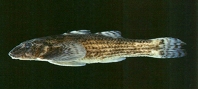
Spine dorsali (totale) : 8; Raggi dorsali molli (totale) : 8 - 9; Spine anali: 1; Raggi anali molli: 8 - 9. Characterized by having enlarged, thickened and wide pectoral fins; widely spaced broad fleshy pelvic fin; head and snout flattened, small dorsolaterally oriented eyes; small ventrally placed mouth; accessory lateral line canals dorsal and ventral to the lateral line on the body, including caudal fin base; caudal fin large (Ref. 92840).
Body shape (shape guide): elongated.
Adults inhabit relatively steep gradient coastal streams in hilly or mountainous terrain. They feed on algae and diatoms; effectively clings on rocks and boulders with its broadened pelvic and pectoral fins and flattened head and snout (Ref. 92840).
Ciclo vitale e comportamento di accoppiamento
Maturità | Riproduzione | Deposizione | Uova | Fecondità | Larve
Allen, G.R., 1991. Field guide to the freshwater fishes of New Guinea. Publication, no. 9. 268 p. Christensen Research Institute, Madang, Papua New Guinea. (Ref. 2847)
Stato della Lista Rossa IUCN (Ref. 130435: Version 2025-2 (Global))
Minaccia per l'uomo
Harmless
Usi umani
Pesca: scarso interesse commerciale
Strumenti
Rapporti speciali
Scarica XML
Fonti Internet
Stime basate su modelli
Indice di diversità filogenetica (Fonte Biblio.
82804): PD
50 = 0.8750 [Uniqueness, from 0.5 = low to 2.0 = high].
Bayesian length-weight: a=0.00389 (0.00180 - 0.00842), b=3.12 (2.94 - 3.30), in cm total length, based on all LWR estimates for this body shape (Ref.
93245).
Livello trofico (Fonte Biblio.
69278): 3.6 ±0.5 se; based on size and trophs of closest relatives
Vulnerabilità della pesca (Ref.
59153): Low vulnerability (21 of 100).
🛈