>
Eupercaria/misc (Various families in series Eupercaria) >
Sparidae (Porgies)
Etymology: Acanthopagrus: Greek, akantha = thorn + Greek, pagros, a kind of fish (Ref. 45335).
More on author: Forsskål.
Ambiente: milieu / zona climatica / distribuzione batimetrica / gamma di distribuzione
Ecologia
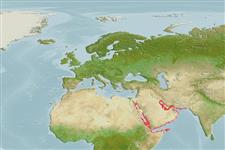
marino; salmastro associati a barriera corallina; distribuzione batimetrica 2 - 20 m (Ref. 9710). Tropical; 32°N - 10°N, 33°E - 65°E (Ref. 95256)
Western Indian Ocean: Red Sea (Israel, Egypt, Eritrea, Saudi Arabia), Persian Gulf (Bahrain and Kuwait), off southern Oman (not Gulf of Oman); presumably along the whole southern coast of the Arabian Peninsula, also Iran to Pakistan.
Lunghezza alla prima maturità / Dimensione / Peso / Età
Maturità: Lm 26.4 range ? - ? cm
Max length : 36.2 cm SL maschio/sesso non determinato; (Ref. 95256); common length : 40.0 cm TL maschio/sesso non determinato; (Ref. 5450); Età massima riportata: 19 anni (Ref. 3625)
Breve descrizione
Chiavi di identificazione | Morfologia | Morfometria
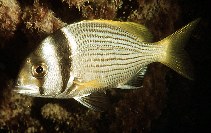
Spine dorsali (totale) : 11; Raggi dorsali molli (totale) : 12 - 15; Spine anali: 3; Raggi anali molli: 10 - 11. This species is distinguished from its congeners by the following set of characters: 2 conspicuous vertical black bars across the head, with the first bar from occiput through eye and across cheek to rear end of maxilla. while the second bar is from nape to opercle; colour of dorsal and caudal fins yellow, without dense black margin of dorsal-fin or narrow black edge along rear margin of caudal fin; scale rows from 5th dorsal fin spine to lateral line 5 ½ or 6 ½ ; base of dorsal and anal fins are scaly; naked interorbital area and preopercle flange; along each side of upper jaw with 2 rows of molars, with the outer molar teeth row extending to rear end of both jaws; basal width of incisor teeth (usually 6) at front of upper jaw smaller, 0.7?0.8 mm for 15 cm SL fish and 2.2?2.5 mm for fish of 34 cm SL, respectively; D XI,12?15, no elongated spines; A III,10?11, with the 2nd and 3rd anal-fin spines subequal and not enlarged (Ref. 95256).
Body shape (shape guide): fusiform / normal; Cross section: compressed.
Occur in small groups. (Ref. 9710). Marketed fresh or dried.
Iwatsuki, Y. and P.C. Heemstra, 2011. A review of the Acanthopagrus bifasciatus species complex (Pisces: Sparidae) from the Indian Ocean, with redescription of A. bifasciatus (Forsskål 1775) and A. catenula (Lacepède 1801). Zootaxa 3025:38-50. (Ref. 95256)
Stato della Lista Rossa IUCN (Ref. 130435: Version 2025-2 (Global))
Minaccia per l'uomo
Harmless
Usi umani
Pesca: scarso interesse commerciale
Strumenti
Rapporti speciali
Scarica XML
Fonti Internet
Stime basate su modelli
Temperatura preferita (Fonte Biblio.
123201): 25 - 29.2, mean 27.6 °C (based on 323 cells).
Indice di diversità filogenetica (Fonte Biblio.
82804): PD
50 = 0.5000 [Uniqueness, from 0.5 = low to 2.0 = high].
Bayesian length-weight: a=0.01585 (0.00996 - 0.02523), b=3.03 (2.90 - 3.16), in cm total length, based on LWR estimates for this species & (Sub)family-body (Ref.
93245).
Livello trofico (Fonte Biblio.
69278): 3.4 ±0.43 se; based on food items.
Resilienza (Fonte Biblio.
120179): Medio, tempo minimo di raddoppiamento della popolazione 1.4 - 4.4 anni (K=0.18; tmax=19).
Vulnerabilità della pesca (Ref.
59153): Moderate vulnerability (37 of 100).
🛈
Vulnerabilità climatica (Ref.
125649): High to very high vulnerability (67 of 100).
🛈
Nutrienti (Ref.
124155): Calcium = 57.6 [28.0, 94.1] mg/100g; Iron = 0.603 [0.332, 1.093] mg/100g; Protein = 19.9 [18.7, 21.2] %; Omega3 = 0.149 [0.097, 0.240] g/100g; Selenium = 22.9 [12.0, 42.3] μg/100g; VitaminA = 81.8 [22.8, 247.2] μg/100g; Zinc = 1.48 [1.01, 2.10] mg/100g (wet weight);