>
Eupercaria/misc (Various families in series Eupercaria) >
Sillaginidae (Smelt-whitings)
Etymology: Sillago: From a locality in Australia.
Ambiente: milieu / zona climatica / distribuzione batimetrica / gamma di distribuzione
Ecologia
marino; salmastro associati a barriera corallina; amfidromo (Ref. 51243); distribuzione batimetrica 0 - 60 m (Ref. 6205), usually 0 - 2 m (Ref. 90102). Tropical; 26°C - 29°C (Ref. 4959); 41°N - 36°S, 20°E - 166°E (Ref. 6205)
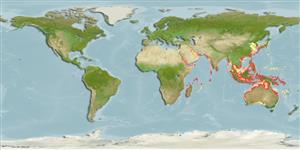
Indo-West Pacific: southern Red Sea (Ref. 94953) and Knysna, South Africa to Japan and south to Australia. Reported from New Caledonia (Ref. 9070). In Japan, this name has often been misapplied to Sillago japonica; often misidentified as Sillago lutea or Sillago vincenti.
Lunghezza alla prima maturità / Dimensione / Peso / Età
Maturità: Lm 16.7, range 13 - 19.1 cm
Max length : 31.0 cm SL maschio/sesso non determinato; (Ref. 44894); common length : 20.0 cm SL maschio/sesso non determinato; (Ref. 9679); Età massima riportata: 7 anni (Ref. 43081)
Spine dorsali (totale) : 11 - 13; Raggi dorsali molli (totale) : 20 - 23; Spine anali: 2; Raggi anali molli: 18 - 23. Swim bladder with two anterior and two posterior extensions. The anterior extensions extend forward and diverge to terminate on each side of the basioccipital above the auditory capsule. Two lateral extensions commence anteriorly, each sending a blind tubule anterolaterally and then extending along the abdominal wall below the investing peritoneum to just posterior of the duct-like process. Two posterior tapering extensions of the swim bladder project into the caudal region, one usually longer than the other. The species has a low lateral line with about 70 scales (Ref. 48635).
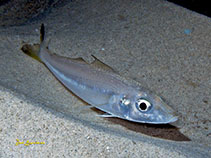
Body shape (shape guide): elongated; Cross section: circular.
Common along beaches, sandbars, mangrove creeks and estuaries. Recorded from freshwater. Form schools. Adults bury themselves in the sand when disturbed (Ref. 6205, 44894). Feed mainly on polychaete worms, small prawns (Penaeus), shrimps and amphipods (Ref. 6226, 6227, 44894). Oviparous (Ref. 205). Larvae and juveniles are pelagic feeding on planktonic (Ref. 43081). Rarely captured by prawn trawling vessels. Marketed fresh and frozen (Ref. 9987).
McKay, R.J., 1992. FAO Species Catalogue. Vol. 14. Sillaginid fishes of the world (family Sillaginidae). An annotated and illustrated catalogue of the sillago, smelt or Indo-Pacific whiting species known to date. Rome: FAO. FAO Fish. Synop. 125(14):87p. (Ref. 6205)
Stato della Lista Rossa IUCN (Ref. 130435: Version 2025-2 (Global))
Minaccia per l'uomo
Harmless
Usi umani
Pesca: commerciale; Acquacoltura: commerciale
Strumenti
Rapporti speciali
Scarica XML
Fonti Internet
Stime basate su modelli
Temperatura preferita (Fonte Biblio.
123201): 24.8 - 29.2, mean 28.5 °C (based on 3250 cells).
Indice di diversità filogenetica (Fonte Biblio.
82804): PD
50 = 0.5000 [Uniqueness, from 0.5 = low to 2.0 = high].
Bayesian length-weight: a=0.00589 (0.00493 - 0.00704), b=3.06 (3.01 - 3.11), in cm total length, based on LWR estimates for this species (Ref.
93245).
Livello trofico (Fonte Biblio.
69278): 3.3 ±0.1 se; based on diet studies.
Resilienza (Fonte Biblio.
120179): Alto, tempo minimo di raddoppiamento della popolazione meno di 15 mesi (K=0.75-1.22; tm=1; tmax=4; Fec=16,682).
Prior r = 0.79, 95% CL = 0.52 - 1.19, Based on 1 data-limited stock assessment.
Vulnerabilità della pesca (Ref.
59153): Low vulnerability (24 of 100).
🛈
Vulnerabilità climatica (Ref.
125649): Moderate vulnerability (43 of 100).
🛈
Nutrienti (Ref.
124155): Calcium = 208 [37, 506] mg/100g; Iron = 0.719 [0.238, 1.909] mg/100g; Protein = 21 [18, 23] %; Omega3 = 0.0971 [, ] g/100g; Selenium = 31 [9, 139] μg/100g; VitaminA = 113 [19, 650] μg/100g; Zinc = 1.42 [0.69, 3.58] mg/100g (wet weight); based on
nutrient studies.