>
Eupercaria/misc (Various families in series Eupercaria) >
Sillaginidae (Smelt-whitings)
Etymology: Sillago: From a locality in Australia.
Окружающая среда: среда / климатическая зона / пределы глубины / диапазон распространения
экология
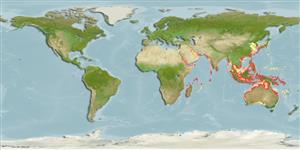
морской; солоноватоводный ассоциированный с рифами; амфидромный (Ref. 51243); пределы глубины 0 - 60 m (Ref. 6205), usually 0 - 2 m (Ref. 90102). Tropical; 26°C - 29°C (Ref. 4959); 41°N - 36°S, 20°E - 166°E (Ref. 6205)
Indo-West Pacific: southern Red Sea (Ref. 94953) and Knysna, South Africa to Japan and south to Australia. Reported from New Caledonia (Ref. 9070). In Japan, this name has often been misapplied to Sillago japonica; often misidentified as Sillago lutea or Sillago vincenti.
Длина при первой зрелости / Размер / Вес / Возраст
половая зрелость: Lm 16.7, range 13 - 19.1 cm
Max length : 31.0 cm SL самец/пол неопределен; (Ref. 44894); common length : 20.0 cm SL самец/пол неопределен; (Ref. 9679); наибольший возраст (опубликованны данные): 7 годы (Ref. 43081)
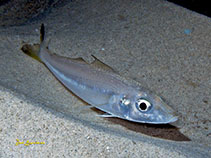
колючие лучи спинного плавника (общее число) : 11 - 13; членистые (мягкие) лучи спинного плавника (общее число) : 20 - 23; колючие лучи анального плавника: 2; членистые (мягкие) лучи анального плавника: 18 - 23. Swim bladder with two anterior and two posterior extensions. The anterior extensions extend forward and diverge to terminate on each side of the basioccipital above the auditory capsule. Two lateral extensions commence anteriorly, each sending a blind tubule anterolaterally and then extending along the abdominal wall below the investing peritoneum to just posterior of the duct-like process. Two posterior tapering extensions of the swim bladder project into the caudal region, one usually longer than the other. The species has a low lateral line with about 70 scales (Ref. 48635).
Body shape (shape guide): elongated; Cross section: circular.
Common along beaches, sandbars, mangrove creeks and estuaries. Recorded from freshwater. Form schools. Adults bury themselves in the sand when disturbed (Ref. 6205, 44894). Feed mainly on polychaete worms, small prawns (Penaeus), shrimps and amphipods (Ref. 6226, 6227, 44894). Oviparous (Ref. 205). Larvae and juveniles are pelagic feeding on planktonic (Ref. 43081). Rarely captured by prawn trawling vessels. Marketed fresh and frozen (Ref. 9987).
McKay, R.J., 1992. FAO Species Catalogue. Vol. 14. Sillaginid fishes of the world (family Sillaginidae). An annotated and illustrated catalogue of the sillago, smelt or Indo-Pacific whiting species known to date. Rome: FAO. FAO Fish. Synop. 125(14):87p. (Ref. 6205)
Статус Красного Списка МСОП (Ref. 130435: Version 2025-2 (Global))
Угроза для людей
Harmless
Использование человеком
рыболовство: коммерческий; аквакультура (рыбоводство): коммерческий
дополнительная информация
инструменты
Специальные отчеты
Скачать в формате XML
ресурсы в Интернет
Оценки, основанные на моделях
Предпочтительная температура (ссылка
123201): 24.8 - 29.2, mean 28.5 °C (based on 3250 cells).
Индекс филогенетического разнообразия (ссылка
82804): PD
50 = 0.5000 [Uniqueness, from 0.5 = low to 2.0 = high].
Bayesian length-weight: a=0.00589 (0.00493 - 0.00704), b=3.06 (3.01 - 3.11), in cm total length, based on LWR estimates for this species (Ref.
93245).
Трофический уровень (ссылка
69278): 3.3 ±0.1 se; based on diet studies.
устойчивость к внешним воздействиям (ссылка
120179): высокий, минимальное время удвоения популяции до 15 месяцев (K=0.75-1.22; tm=1; tmax=4; Fec=16,682).
Prior r = 0.79, 95% CL = 0.52 - 1.19, Based on 1 data-limited stock assessment.
Уязвимость рыбной ловли (Ref.
59153): Low vulnerability (24 of 100).
🛈
Климатическая уязвимость (Ref.
125649): Moderate vulnerability (43 of 100).
🛈
Питательные вещества (Ref.
124155): Calcium = 208 [37, 506] mg/100g; Iron = 0.719 [0.238, 1.909] mg/100g; Protein = 21 [18, 23] %; Omega3 = 0.0971 [, ] g/100g; Selenium = 31 [9, 139] μg/100g; VitaminA = 113 [19, 650] μg/100g; Zinc = 1.42 [0.69, 3.58] mg/100g (wet weight); based on
nutrient studies.