>
Blenniiformes (Blennies) >
Tripterygiidae (Triplefin blennies) > Tripterygiinae
Etymology: Bellapiscis: Latin, bellum = war + Latin, piscis = fish.
Eponymy: Dr Lesley Anne Bolton-Ritchie is a New Zealand marine biologist. [...] (Ref. 128868), visit book page.
Environnement : milieu / zone climatique / profondeur / gamme de distribution
Écologie
marin démersal; non migrateur; profondeur 0 - 5 m (Ref. 13227). Temperate
Distribution
Territoires | Zones FAO | Écosystèmes | Occurrences | Carte par point | Introductions | Faunafri
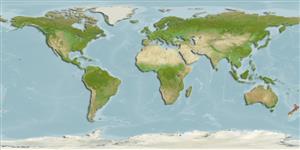
Southwest Pacific: New Zealand.
Longueur à la première maturité / Taille / Poids / Âge
Maturité: Lm 4.3, range 4 - 4.5 cm
Max length : 6.0 cm SL mâle / non sexé; (Ref. 13227); âge max. reporté: 3.00 années (Ref. 13227)
Description synthétique
Clés d'identification | Morphologie | Morphométrie
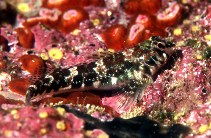
Épines dorsales (Total) : 18 - 21; Rayons mous dorsaux (Total) : 10 - 15; Épines anales: 2; Rayons mous anaux: 17 - 22. With 17-22 soft anal fin rays, 17-25 lateral line scales, 35-42 +1 total lateral scale rows, and the body with an irregular or without a checker-board pattern, extending to level of belly.
Body shape (shape guide): fusiform / normal; Cross section: oval.
Facultative air-breathing in the genus (Ref. 126274); Adults are found predominantly in tide pools and upper subtidal areas. Are solitary. They feed mainly on amphipods, isopods, polychaetes, and small gastropods. Males may defend small breeding territories during the breeding season (Ref 13227). Eggs are hemispherical and covered with numerous sticky threads that anchor them in the algae on the nesting sites (Ref. 240). Larvae are planktonic which occur primarily in shallow, nearshore waters (Ref. 94114).
Eggs are laid in empty barnacle shells found in rocky areas. The nest is guarded by the male while the eggs are covered with water. Juveniles are found in the intertidal region between August and December (Ref. 13227).
Fricke, R., 1994. Tripterygiid fishes of Australia, New Zealand and the southwest Pacific Ocean (Teleostei). Theses Zool. 24:1-585. (Ref. 13227)
Statut dans la liste rouge de l'IUCN (Ref. 130435: Version 2025-2 (Global))
Menace pour l'homme
Harmless
Utilisations par l'homme
Pêcheries: sans intérêt
Outils
Articles particuliers
Télécharger en XML
Sources Internet
Estimations basées sur des modèles
Température préférée (Réf.
123201): 13 - 19.8, mean 16.4 °C (based on 118 cells).
Indice de diversité phylogénétique (Réf.
82804): PD
50 = 0.7500 [Uniqueness, from 0.5 = low to 2.0 = high].
Bayesian length-weight: a=0.00692 (0.00361 - 0.01325), b=3.08 (2.91 - 3.25), in cm total length, based on LWR estimates for this species & (Sub)family-body (Ref.
93245).
Niveau trophique (Réf.
69278): 3.3 ±0.48 se; based on food items.
Résilience (Réf.
120179): Haut, temps minimum de doublement de population inférieur à 15 mois (tm=1; tmax=3).
Vulnérabilité de la pêche (Ref.
59153): Low vulnerability (10 of 100).
🛈