This website uses cookies to enhance your browsing experience and ensure the functionality of our site. For more detailed information about the types of cookies we use and how we protect your privacy, please visit our Privacy Information page.
×
Cookie Settings
This website uses different types of cookies to enhance your experience. Please select your preferences below:
Teleostei > Cypriniformes (Carps) > Gobionidae (Gudgeons)
Etymology: Pseudorasbora:Greek, pseudes = false + Rasbora, an Indian word for a fish, also used in Malay peninsula. More on authors: Temminck & Schlegel.
Asia: Amur to Zhujiang [Pearl River] drainages in Siberia, Korea and China (Ref. 59043). Introduced to various areas in Europe and Asia. Several countries report adverse ecological impact after introduction (Ref. 1739). 亞洲: 日本南部與中部,台灣,韓國,中國,阿穆爾河流域。 引進了歐洲各地與亞洲 (參考文獻 1739) 而且現在出現於聶伯河,第聶伯河,多瑙河流域,斯庫台利湖與普雷帕斯湖與希臘的 Aliakmon 河中。 (參考文獻 26334) 引入後的一些國家報告不利的生態衝擊。 也在伊朗與土庫曼引入。 (參考文獻 39702)
初熟時的長度 / 大小 / 重量 / 年齡
成熟度: Lm3.0 range ? - ? cm Max length : 12.5 cm TL 雄魚/尚未辨別雌雄; (Ref. 88166); common length : 8.0 cm TL 雄魚/尚未辨別雌雄; (Ref. 1441); 最大年齡: 5 年 (Ref. 56557)
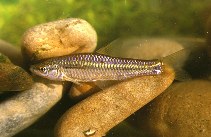
背棘 (總數) : 3; 背的軟條 (總數) : 7; 臀棘: 3; 臀鰭軟條: 6. Mouth superior and transverse; 6 branched anal rays; barbels absent; distal margin of dorsal convex; large adults with sexually dimorphic coloration (Ref. 43281). Body shape (shape guide): fusiform / normal. 嘴上位且橫向; 6個分枝的臀鰭鰭條; 觸鬚不存在; 背部凸狀的末梢部邊緣; 大的成魚有性別雙型性顏色。 (參考文獻 43281)
Found in a wide variety of habitats, most abundantly in well vegetated small channels, ponds and small lakes (Ref. 59043). Adults occur in cool running water. Feed on small insects, fish and fish eggs (Ref. 30578), and plant material (Ref. 59043). Usually breed in habitats with still or very slow-flowing water (Ref. 59043). Females spawn 3-4 times in a season (Ref. 59043). Males clear the surface of the spawning site and guard the eggs until they hatch (Ref. 59043). Regarded as pest which competes with the fry of other species due to its high reproductive rate (Ref. 1739).
Nests under stones and the male cleans the cavity with its pearl organs. Eggs adhere to the ceiling of the cavity. The male leaves the nest before the eggs hatch. Females spawn 3-4 times during a season (Ref. 59043).亞洲: 日本南部與中部,台灣,韓國,中國,阿穆爾河流域。 引進了歐洲各地與亞洲 (參考文獻 1739) 而且現在出現於聶伯河,第聶伯河,多瑙河流域,斯庫台利湖與普雷帕斯湖與希臘的 Aliakmon 河中。 (參考文獻 26334) 引入後的一些國家報告不利的生態衝擊。 也在伊朗與土庫曼引入。 (參考文獻 39702)