Holocephali (chimaeras) (chimaeras) >
Chimaeriformes (Chimaeras) >
Callorhinchidae (Plownose chimaeras)
Etymology: Callorhinchus: Tautonymous with Chimaera callorynchus Linnaeus 1758 (but unnecessarily emended from -rynchus to -rhinchus: callum (L.), hard skin; rhynchus (L.), snout, referring to peculiar hoe-shaped proboscis (See ETYFish); milii: In honor of Bory de Saint-Vincent’s “old friend” (translation) Pierre Bernard Milius (1773‒1829), a French naval officer, naturalist and civil servant, who supplied specimen upon which description and its accompanying illustration (shown here) were based; (See ETYFish).
Eponymy: Baron Pierre Bernard Milius (1773–1829) was a French naval officer, naturalist and civil servant who took part in an exploratory voyage (1804) of the Mascarene Islands, Indian Ocean, under Nicolas Baudin, during which he became friends with Bory. [...] (Ref. 128868), visit book page.
Lingkungan: lingkungan / zona iklim / kisaran kedalaman / jangkauan distribusi
Ekologi
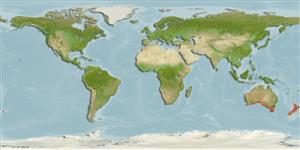
laut; payau dasar (demersal); oceanodromus (Ref. 51243); kisaran kedalaman 0 - 227 m (Ref. 26346). Subtropical; 33°S - 50°S
Southwest Pacific: southern Australia and New Zealand.
Panjang pada saat jatuh tempo pertama / Ukuran / Berat / umur
Kematangan: Lm 71.0, range 70 - ? cm
Max length : 125 cm TL jantan/; (Ref. 26346); common length : 75.0 cm TL jantan/; (Ref. 9258)
deskripsi pendek
Kunci identifiaksi (pengenalan) | Morfologi | Morfometrik
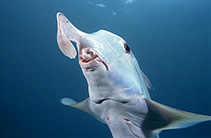
Occurs on continental shelves to depths of at least 200 m (Ref. 6871). Migrates into large estuaries and inshore bays in the spring to breed (Ref. 6871). Feeds mainly on shellfish (Ref. 26346). Oviparous (Ref. 50449). Eggs are encased in horny shells (Ref. 205). Flesh is of good eating quality. Males have a small, club-like protuberance on the head and also long copulation organs near the pelvic fins (Ref. 557).
Migrates into large estuaries and inshore bays in the spring to breed (Ref. 6871). Oviparous, two egg cases (Ref. 26346) are laid on sandy or muddy bottoms and take up to 8 months to hatch (Ref. 6871). Embryos feed solely on yolk (Ref. 50449).Young hatch at about 15 cm (Ref. 26346).
Last, P.R. and J.D. Stevens, 1994. Sharks and rays of Australia. CSIRO, Australia. 513 p. (Ref. 6871)
Status IUCN Red List (Ref. 130435: Version 2025-2 (Global))
ancaman kepada manusia
Harmless
penggunaan manusia
Perikanan: komersial
Alat, peralatan
laporan khas
muat turun XML
Sumber internet
Estimasi berdasarkan model
Suhu yang disukai (Acuan
123201): 12.1 - 18.2, mean 15.2 °C (based on 179 cells).
Indeks keanekaragaman filogenetik (Acuan
82804): PD
50 = 0.7500 [Uniqueness, from 0.5 = low to 2.0 = high].
Bayesian length-weight: a=0.00479 (0.00194 - 0.01180), b=3.13 (2.91 - 3.35), in cm total length, based on LWR estimates for this species & (Sub)family-body (Ref.
93245).
Tingkat Trofik (Acuan
69278): 3.6 ±0.29 se; based on food items.
Daya lenting (Acuan
120179): Rendah, Waktu penggandaan populasi minimum 4.5 - 14 tahun (K=0.06-0.47; tm=2-6; Fec=2).
Kerentanan Penangkapan Ikan (Ref.
59153): High vulnerability (55 of 100).
🛈
Kerentanan Iklim (Ref.
125649): Very high vulnerability (83 of 100).
🛈
Nutrisi (Ref.
124155): Calcium = 25.5 [6.4, 69.6] mg/100g; Iron = 0.758 [0.284, 2.957] mg/100g; Protein = 14.3 [11.2, 18.8] %; Omega3 = 0.258 [0.116, 0.579] g/100g; Selenium = 32 [9, 84] μg/100g; VitaminA = 7.14 [3.03, 17.16] μg/100g; Zinc = 0.661 [0.338, 1.252] mg/100g (wet weight);