Umwelt: Milieu / Klimazone / Tiefenbereich / Verbreitungsgebiet
Ökologie
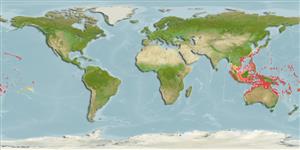
seewasser riff-verbunden; tiefenbereich 3 - 46 m (Ref. 1602), usually 9 - 46 m (Ref. 1602). Tropical; 24°C - 28°C (Ref. 27115); 35°N - 32°S, 95°E - 139°W
Pacific Ocean: Christmas Island and Cocos-Keeling Islands in the eastern Indian Ocean to the Hawaiian and Tuamoto islands, north to Japan, south to Lord Howe Island. Replaced by Acanthurus tennenti in the Indian Ocean (Ref. 37816).
Größe / Gewicht / Alter
Geschlechtsreife: Lm ? range ? - ? cm
Max length : 35.0 cm TL Männchen/unbestimmt; (Ref. 2334); max. veröff. Alter: 33 Jahre (Ref. 52229)
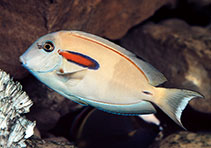
Rückenflossenstacheln (insgesamt) : 9; Rückenflossenweichstrahlen (insgesamt) : 23 - 25; Afterflossenstacheln: 3; Afterflossenweichstrahlen: 22 - 24. Body of adult dark grayish brown; juveniles yellow; posterior to upper end of gill opening is a bright orange horizontal band, with purplish black border. Head and anterior half of body usually abruptly paler than the posterior half. Anterior gill rakers 24-28; posterior 23-27. Large adult males (about 17 cm) with more definite convexity of snout profile.
Body shape (shape guide): short and / or deep; Cross section: compressed.
Inhabit seaward reefs, in areas of bare rock or mixed rubble and sand, from 9 to at least 46 m depth; juveniles inhabit protected bays and lagoons, singly or in small groups in as little as 3 m (Ref. 1602, 48637). Benthopelagic (Ref. 58302). Adults occur singly or in schools and feed on surface film of detritus, diatoms, and fine filamentous algae covering sand and bare rock (Ref. 1602). Rarely poisonous (Ref. 4795).
Lebenszyklus und Paarungsverhalten
Geschlechtsreife | Fortpflanzung | Ablaichen | Eier | Fruchtbarkeit | Larven
Randall, J.E., 1956. A revision of the surgeonfish genus Acanthurus. Pac. Sci. 10(2):159-235. (Ref. 1920)
IUCN Rote Liste Status (Ref. 130435: Version 2025-2 (Global))
Nutzung durch Menschen
Fischereien: kommerziell; Aquarium: Kommerziell
Tools
Zusatzinformationen
Download XML
Internet Quellen
Schätzungen auf der Grundlage von Modellen
Bevorzugte Temperatur (Ref.
123201): 24.5 - 28.7, mean 27.3 °C (based on 356 cells).
Phylogenetischer Diversitätsindex (Ref.
82804): PD
50 = 0.5000 [Uniqueness, from 0.5 = low to 2.0 = high].
Bayesian length-weight: a=0.02570 (0.01664 - 0.03970), b=3.01 (2.88 - 3.14), in cm total length, based on LWR estimates for this species & Genus-body shape (Ref.
93245).
Trophische Ebene (Ref.
69278): 2.3 ±0.17 se; based on food items.
Generation time: 1.0 ( na - na) years. Estimated as median ln(3)/K based on 1
growth studies.
Widerstandsfähigkeit (Ref.
120179): sehr niedrig, Verdopplung der Population dauert mehr als 14 Jahre. (tmax=33).
Anfälligkeit der Fischerei (Ref.
59153): Low vulnerability (18 of 100).
🛈
Nährstoffe (Ref.
124155): Calcium = 69.2 [29.5, 211.4] mg/100g; Iron = 0.926 [0.341, 2.370] mg/100g; Protein = 18.5 [17.2, 19.7] %; Omega3 = 0.109 [0.049, 0.238] g/100g; Selenium = 23.8 [8.1, 73.5] μg/100g; VitaminA = 23.6 [5.9, 93.8] μg/100g; Zinc = 2.68 [0.83, 4.91] mg/100g (wet weight);