Acanthurus olivaceus, Orangespot surgeonfish : fisheries, aquarium

You can sponsor this page

Acanthurus olivaceus Bloch & Schneider, 1801

Orangespot surgeonfish
Aggiungete la vostra osservazione in Fish Watcher
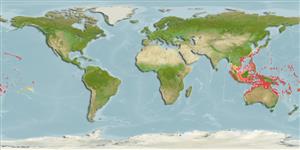
Native range
This map was computer-generated and has not yet been reviewed.
Acanthurus olivaceus   AquaMaps   Data sources: GBIF OBIS
Carica il tuo foto e Video
Immagini | Video | Google image
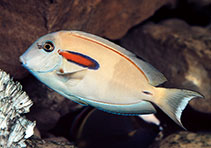
Image of Acanthurus olivaceus (Orangespot surgeonfish)
Acanthurus olivaceus
Immagine di Muséum-Aquarium de Nancy/D. Terver

Classificazione / Nomi Nomi Comuni | Sinonimi | Catalog of Fishes(Genere, Specie) | ITIS | CoL | WoRMS | Cloffa

> Acanthuriformes (Surgeonfishes) > Acanthuridae (Surgeonfishes, tangs, unicornfishes) > Acanthurinae
Etymology: Acanthurus: Greek, akantha = thorn + Greek, oura = tail (Ref. 45335).
More on authors: Bloch & Schneider.

Ambiente: milieu / zona climatica / distribuzione batimetrica / gamma di distribuzione Ecologia

marino associati a barriera corallina; distribuzione batimetrica 3 - 46 m (Ref. 1602), usually 9 - 46 m (Ref. 1602). Tropical; 24°C - 28°C (Ref. 27115); 35°N - 32°S, 95°E - 139°W

Distribuzione Territories | Aree FAO | Ecosistemi | Presenze | Mappa dei ritrovamenti | Introduzioni | Faunafri

Pacific Ocean: Christmas Island and Cocos-Keeling Islands in the eastern Indian Ocean to the Hawaiian and Tuamoto islands, north to Japan, south to Lord Howe Island. Replaced by Acanthurus tennenti in the Indian Ocean (Ref. 37816).

Dimensione / Peso / Età

Maturità: Lm ?  range ? - ? cm
Max length : 35.0 cm TL maschio/sesso non determinato; (Ref. 2334); Età massima riportata: 33 anni (Ref. 52229)

Breve descrizione Chiavi di identificazione | Morfologia | Morfometria

Spine dorsali (totale) : 9; Raggi dorsali molli (totale) : 23 - 25; Spine anali: 3; Raggi anali molli: 22 - 24. Body of adult dark grayish brown; juveniles yellow; posterior to upper end of gill opening is a bright orange horizontal band, with purplish black border. Head and anterior half of body usually abruptly paler than the posterior half. Anterior gill rakers 24-28; posterior 23-27. Large adult males (about 17 cm) with more definite convexity of snout profile.
Body shape (shape guide): short and / or deep; Cross section: compressed.

Biologia     Glossario (es. epibenthic)

Inhabit seaward reefs, in areas of bare rock or mixed rubble and sand, from 9 to at least 46 m depth; juveniles inhabit protected bays and lagoons, singly or in small groups in as little as 3 m (Ref. 1602, 48637). Benthopelagic (Ref. 58302). Adults occur singly or in schools and feed on surface film of detritus, diatoms, and fine filamentous algae covering sand and bare rock (Ref. 1602). Rarely poisonous (Ref. 4795).

Ciclo vitale e comportamento di accoppiamento Maturità | Riproduzione | Deposizione | Uova | Fecondità | Larve

Riferimento principale Caricare le referenze | Bibliografia | Coordinatore : Randall, John E. | Collaboratori

Randall, J.E., 1956. A revision of the surgeonfish genus Acanthurus. Pac. Sci. 10(2):159-235. (Ref. 1920)

Stato della Lista Rossa IUCN (Ref. 130435: Version 2025-2 (Global))

  Least Concern (LC) ; Date assessed: 04 May 2010

CITES

Not Evaluated

CMS (Ref. 116361)

Not Evaluated

Minaccia per l'uomo

  Harmless (Ref. 4795)


Usi umani

Pesca: commerciale; Acquario: Commerciale
FAO - Publication: search | FishSource | Sea Around Us

Informazioni ulteriori

Ecologia trofica
Articoli alimentari (prede)
Alimentazione
Consumo di cibo
Razioni alimentari
Predatori
Ecologia
Ecologia
Dinamica della popolazione
Parametri di crescita
Età massima / dimensioni massime
Rapporto lunghezza-peso.
Lunghezza-lunghezza rel.
Lunghezza-frequenze
Conversione di massa
Reclutamento
Abbondanza
Ciclo di vita
Riproduzione
Maturità
Maturità/Gli occhielli sono relativi.
Fecondità
Deposizione
Aggregazioni riproduttive
Uova
Sviluppo delle uova
Larve
Dinamica popolazioni larvali
Distribuzione
Territories
Aree FAO
Ecosistemi
Presenze
Introduzioni
BRUVS - Video
Anatomia
Area branchiale
Cervello
Otolite
Fisiologia
Composizione corporea
Nutrienti
Consumo di ossigeno
Tipo di nuoto
Velocità di nuoto
Pigmenti visivi
Suono del pesce
Malattie e parassiti
Tossicità (LC50)
Genetica
Genome
Genetica
Eterozigosi
Ereditarietà
Diversità genetica
Legato all'uomo
Sistemi di acquacoltura
Profili di acquacoltura
Varietà
Casi di Ciguatera
Francobolli, monete, materiale vario.
Raggiungimento
Collaboratori
Bibliografia
Bibliografia

Strumenti

Rapporti speciali

Scarica XML

Fonti Internet

AFORO (otoliths) | Aquatic Commons | BHL | Cloffa | Websites from users | Check FishWatcher | CISTI | Catalog of Fishes: Genere, Specie | DiscoverLife | ECOTOX | FAO - Publication: search | Faunafri | Fishipedia | Fishtrace | GloBI | Google Books | Google Scholar | Google | IGFA World Record | Database Nazionali | OneZoom | Open Tree of Life | Otolith Atlas of Taiwan Fishes | Acquari pubblici | PubMed | Reef Life Survey | Socotra Atlas | TreeBase | Tree of Life | Wikipedia: Go, ricerca | World Records Freshwater Fishing | Zoobank | Record zoologico

Stime basate su modelli

Temperatura preferita (Fonte Biblio. 123201): 24.5 - 28.7, mean 27.3 °C (based on 356 cells).
Indice di diversità filogenetica (Fonte Biblio. 82804):  PD50 = 0.5000   [Uniqueness, from 0.5 = low to 2.0 = high].
Bayesian length-weight: a=0.02570 (0.01664 - 0.03970), b=3.01 (2.88 - 3.14), in cm total length, based on LWR estimates for this species & Genus-body shape (Ref. 93245).
Livello trofico (Fonte Biblio. 69278):  2.3   ±0.17 se; based on food items.
Generation time: 1.0 ( na - na) years. Estimated as median ln(3)/K based on 1 growth studies.
Resilienza (Fonte Biblio. 120179):  Molto basso, tempo minimo di raddoppiamento della popolazione più di 14 anni (tmax=33).
Vulnerabilità della pesca (Ref. 59153):  Low vulnerability (18 of 100). 🛈
Categoria di prezzo (Ref. 80766):   Medium.
Nutrienti (Ref. 124155):  Calcium = 69.2 [29.5, 211.4] mg/100g; Iron = 0.926 [0.341, 2.370] mg/100g; Protein = 18.5 [17.2, 19.7] %; Omega3 = 0.109 [0.049, 0.238] g/100g; Selenium = 23.8 [8.1, 73.5] μg/100g; VitaminA = 23.6 [5.9, 93.8] μg/100g; Zinc = 2.68 [0.83, 4.91] mg/100g (wet weight);