>
Anguilliformes (Eels and morays) >
Muraenidae (Moray eels) > Muraeninae
Etymology: Gymnothorax: Greek, gymnos = naked + Greek, thorax, -akos = breast (Ref. 45335).
More on author: Lacepède.
Environnement : milieu / zone climatique / profondeur / gamme de distribution
Écologie
marin; saumâtre récifal; profondeur 0 - 110 m (Ref. 58302). Tropical; 32°N - 28°S
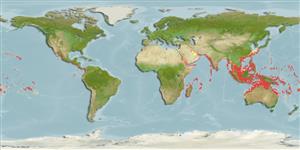
Indo-Pacific: Red Sea and East Africa, including Walters Shoal (Ref. 33390) and Persian Gulf (Ref. 68964) to French Polynesia, north to southern Japan and the Hawaiian Islands, south to the southern Great Barrier Reef. Eastern Central Pacific: Costa Rica and Panama (Ref. 9324).
Longueur à la première maturité / Taille / Poids / Âge
Maturité: Lm ?, range 77 - ? cm
Max length : 150 cm TL mâle / non sexé; (Ref. 1602)
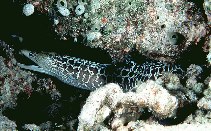
Épines dorsales (Total) : 0; Rayons mous dorsaux (Total) : 0; Épines anales: 0; Rayons mous anaux: 0; Vertèbres: 126 - 138. Distinctive pattern of light undulating lines and speckles on a dark green background. Snout often yellow (Ref. 30404).
Body shape (shape guide): eel-like.
A common species on reef flats among rocks, rubble, or debris and also occurs in lagoons and seaward reefs to depths of 26 m or more. Minimum depth reported taken from Ref. 86942. Cavernicolous (Ref. 8593, 58302). Benthic (Ref. 58302). Nocturnal species that feeds on fishes, octopi, and probably crustaceans. Reported to be an aggressive species and prone to bite. Used in Chinese medicine (Ref. 12166).
Cycle de vie et comportement reproducteur
Maturité | Reproduction | Frai | Œufs | Fécondité | Larves
Chen, H.-M., K.-T. Shao and C.T. Chen, 1994. A review of the muraenid eels (Family Muraenidae) from Taiwan with descriptions of twelve new records. Zool. Stud. 33(1):44-64. (Ref. 6934)
Statut dans la liste rouge de l'IUCN (Ref. 130435: Version 2025-2 (Global))
Menace pour l'homme
Reports of ciguatera poisoning (Ref. 4690)
Utilisations par l'homme
Pêcheries: intérêt commercial mineur; Aquarium: Commercial
Outils
Articles particuliers
Télécharger en XML
Sources Internet
Estimations basées sur des modèles
Température préférée (Réf.
123201): 24.3 - 29, mean 28 °C (based on 1810 cells).
Indice de diversité phylogénétique (Réf.
82804): PD
50 = 0.5000 [Uniqueness, from 0.5 = low to 2.0 = high].
Bayesian length-weight: a=0.00063 (0.00040 - 0.00100), b=3.28 (3.15 - 3.41), in cm total length, based on LWR estimates for this species & Genus-body shape (Ref.
93245).
Niveau trophique (Réf.
69278): 3.6 ±0.3 se; based on diet studies.
Résilience (Réf.
120179): Très faible, temps minimum de doublement de population supérieur à 14 ans (Preliminary K or Fecundity.).
Vulnérabilité de la pêche (Ref.
59153): Very high vulnerability (90 of 100).
🛈
Nutriments (Ref.
124155): Calcium = 20.2 [10.4, 35.7] mg/100g; Iron = 0.389 [0.227, 0.745] mg/100g; Protein = 18.9 [16.6, 21.4] %; Omega3 = 0.106 [0.047, 0.280] g/100g; Selenium = 59.2 [30.5, 113.3] μg/100g; VitaminA = 41.7 [11.5, 148.7] μg/100g; Zinc = 1.03 [0.71, 1.46] mg/100g (wet weight);