>
Pleuronectiformes (Flatfishes) >
Cyclopsettidae (Sand whiffs)
Etymology: Citharichthys: Latin, cithara = lire like instrument + Greek, ichthys = fish (Ref. 45335).
Eponymy: Franz Xaver Stampfli (1847–1903) was a German (possibly Swiss) naturalist who was working in Liberia (1879–1887). [...] (Ref. 128868), visit book page.
More on author: Steindachner.
Ambiente: milieu / zona climatica / distribuzione batimetrica / gamma di distribuzione
Ecologia
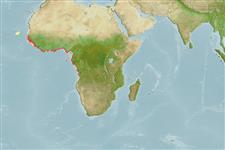
marino; acqua dolce; salmastro demersale; distribuzione batimetrica 0 - 50 m (Ref. 2683). Tropical; 21°N - 18°S, 26°W - 20°E
Eastern Atlantic: Mauritania to Angola, including Cape Verde.
Dimensione / Peso / Età
Maturità: Lm ? range ? - ? cm
Max length : 17.6 cm TL maschio/sesso non determinato; (Ref. 128374); peso massimo pubblicato: 73.00 g (Ref. 126037)
Breve descrizione
Chiavi di identificazione | Morfologia | Morfometria
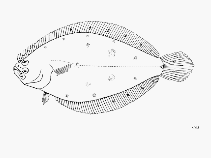
Spine dorsali (totale) : 0; Raggi dorsali molli (totale) : 80 - 87; Spine anali: 0; Raggi anali molli: 59 - 65. Diagnosis: body oval, its depth 45-50% SL (Ref. 81290, 81683). Head length 27-31% SL; eye diameter 16-23% HL; teeth in a single row on upper as well as lower jaw, no caniniform teeth (Ref. 81683). Interorbital space narrow and slightly concave (Ref. 81290, 81683). Hind end of maxilla extending to below centre of eye (Ref. 81290, 81683) but never posterior to posterior edge of pupil (Ref. 81683). Fin base length of both pelvic fins short and of about equal length (Ref. 81683). Body covered with cycloid or weakly ctenoid scales (Ref. 81290, 81683). Gill rakers moderately long and slender (Ref. 81290, 81683), about 2/3-3/4 length of gill filaments at angle of gill arch (Ref. 81683).
Coloration: eyed side yellowish brown with dark spots along dorsal and anal fins; dark brown spot at base of caudal fin, as well as on upper and lower caudal fin rays; dorsal and anal fins with a series of dark brown spots; blind side entirely whitish (Ref. 81620, 81683).
Body shape (shape guide): short and / or deep; Cross section: flattened.
Occurs in coastal waters (Ref. 2683, 81290) and brackish water of estuaries and lagoons (Ref. 81290, 81683), also ascending rivers (Ref. 81683) and entering freshwater (Ref. 2683). Feeds on fish, shrimps and crabs (Ref. 28587).
Ciclo vitale e comportamento di accoppiamento
Maturità | Riproduzione | Deposizione | Uova | Fecondità | Larve
Distinct pairing (Ref. 205). Oviparous (Ref. 101737). Females produce numerous eggs in multiple spawnings during a prolonged spawning period (Ref. 101737).
Aldebert, Y., M. Desoutter and J.-C. Quéro, 1990. Bothidae. p. 1027-1036. In J.C. Quero, J.C. Hureau, C. Karrer, A. Post and L. Saldanha (eds.) Check-list of the fishes of the eastern tropical Atlantic (CLOFETA). JNICT, Lisbon; SEI, Paris; and UNESCO, Paris. Vol. 2. (Ref. 5979)
Stato della Lista Rossa IUCN (Ref. 130435: Version 2025-2 (Global))
Minaccia per l'uomo
Harmless
Usi umani
Pesca: commerciale
Strumenti
Rapporti speciali
Scarica XML
Fonti Internet
Stime basate su modelli
Temperatura preferita (Fonte Biblio.
123201): 23.7 - 28, mean 26.7 °C (based on 66 cells).
Indice di diversità filogenetica (Fonte Biblio.
82804): PD
50 = 0.5000 [Uniqueness, from 0.5 = low to 2.0 = high].
Bayesian length-weight: a=0.00501 (0.00331 - 0.00760), b=3.26 (3.14 - 3.38), in cm total length, based on LWR estimates for this species & Genus-body shape (Ref.
93245).
Livello trofico (Fonte Biblio.
69278): 3.9 ±0.55 se; based on food items.
Resilienza (Fonte Biblio.
120179): Alto, tempo minimo di raddoppiamento della popolazione meno di 15 mesi (Preliminary K or Fecundity.).
Vulnerabilità della pesca (Ref.
59153): Low vulnerability (10 of 100).
🛈
Nutrienti (Ref.
124155): Calcium = 279 [133, 549] mg/100g; Iron = 1.31 [0.64, 2.52] mg/100g; Protein = 17.1 [15.0, 19.1] %; Omega3 = 0.167 [0.079, 0.343] g/100g; Selenium = 48.1 [21.8, 105.2] μg/100g; VitaminA = 15.6 [4.7, 57.4] μg/100g; Zinc = 1.36 [0.89, 2.02] mg/100g (wet weight);