Milieu: milieu / Klimaatzone / Diepte / verspreidingsgebied
Ecologie
marien; zoet water; brak water demersaal. Temperate
Eurasia: Caspian Sea; in Volga upriver to Astrakhan until 1977, spreaded out to Lakes Ivankovskoje and Rybinskoje (2000); invaded Don drainage (Black Sea basin) through Volga-Don canal (first record in 1972). Abundant in Lake Tsimlyansk and lower Don.
Grootte / Gewicht / Leeftijd
Maturiteit: Lm ? range ? - ? cm
Max length : 32.6 cm TL mannelijk / geslacht onbekend; (Ref. 85452); common length : 12.0 cm SL mannelijk / geslacht onbekend; (Ref. 2058)
Korte beschrijving
Determinatiesleutels | Morfologie | Morfometrie
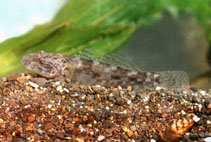
This species is distinguished from its congeners in the Caspian Sea basin by the following characters: 75-95 % of distance between its origin and anus; ctenoid scales completely cover predorsal area and nape; pelvic disc fraenum with angular lobes, fraenum length 1/6-1/2 of its width at base; scales in midlateral series 68-72 + 3-4; snout length 1.5-1.6 times in eye diameter; interorbital distance 0.8-0.9 times eye diameter; first branched ray of second dorsal about as long as penultimate ray; posterior part of first dorsal without black spot. This species is different from N. kessleri in the area in having a distinctive karyotype, some osteological characters and cycloid scales on opercle and anterior part of the nape (vs. ctenoid) (Ref. 59043).
Body shape (shape guide): fusiform / normal.
Inhabitant of inshore areas, estuaries, brackish and fresh water of lagoons and lakes, large rivers, harbours, on rock (stone or firm sand) bottom; mainly on well vegetated bottom (Ref.13696, 59043). Most females spawn for the first time at 1 year, males at 2 years, in April-May, rarely until July. Adhesive eggs are deposited on stones, shells and aquatic plants and the males guard the eggs after hatching. Feeds mostly on small fish, as well as a wide variety of invertebrates (Ref.59043).
Levenscyclus en paargedrag
Maturiteit | Voortplanting | Paaien | Eieren | Fecunditeit | Larven
Kottelat, M., 1997. European freshwater fishes. An heuristic checklist of the freshwater fishes of Europe (exclusive of former USSR), with an introduction for non-systematists and comments on nomenclature and conservation. Biologia, Bratislava, 52/Suppl. 5:1-271. (Ref. 13696)
Status op de Rode Lijst van het IUCN (Ref. 130435: Version 2025-2 (Global))
Gevaar voor de mens
Harmless
Gebruik door de mens
Tools
Speciale rapporten
Download XML
Internetbronnen
Schattingen op basis van modellen
Fylogenetische diversiteitsindex (Ref.
82804): PD
50 = 0.5000 [Uniqueness, from 0.5 = low to 2.0 = high].
Bayesian length-weight: a=0.01259 (0.00631 - 0.02511), b=3.24 (3.08 - 3.40), in cm total length, based on LWR estimates for this species & Genus-body shape (Ref.
93245).
Trofisch niveau (Ref.
69278): 3.8 ±0.4 se; based on diet studies.
Weerstandsvermogen (Ref.
120179): Gemiddeld, minimale populatieverdubbelingstijd 1,4-4,4 jaar (Preliminary K or Fecundity.).
Kwetsbaarheid van de visserij (Ref.
59153): Low vulnerability (23 of 100).
🛈