การจำแนกประเภท / ชื่อ
ชื่อสามัญ | ชื่อพ้อง | Catalog of Fishes(สกุล, ชนิด) | ITIS | CoL | WoRMS | Cloffa
สิ่งแวดล้อม : สิ่งแวดล้อม / เขตภูมิอากาศ / ระดับความลึก / ระยะการกระจายสินค้า
นิเวศวิทยา
เกี่ยวกับทะเล,น้ำเค็ม; น้ำจืด; กร่อย สัตว์น้ำหน้าดิน. Temperate
Eurasia: Caspian Sea; in Volga upriver to Astrakhan until 1977, spreaded out to Lakes Ivankovskoje and Rybinskoje (2000); invaded Don drainage (Black Sea basin) through Volga-Don canal (first record in 1972). Abundant in Lake Tsimlyansk and lower Don.
ขนาด / น้ำหนัก / อายุ
วัยเจริญพันธุ์: Lm ? range ? - ? cm
Max length : 32.6 cm TL เพศผู้/กระเทย; (Ref. 85452); common length : 12.0 cm SL เพศผู้/กระเทย; (Ref. 2058)
คำอธิบายสั้นๆ
เครื่องมือที่ใช้ในการแยกชนิดสัตว์,สิ่งมีชีวิตออกจากกัน | สัณฐานวิทยา | ความยาวต่างๆ
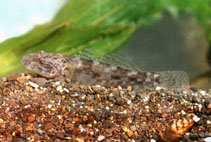
This species is distinguished from its congeners in the Caspian Sea basin by the following characters: 75-95 % of distance between its origin and anus; ctenoid scales completely cover predorsal area and nape; pelvic disc fraenum with angular lobes, fraenum length 1/6-1/2 of its width at base; scales in midlateral series 68-72 + 3-4; snout length 1.5-1.6 times in eye diameter; interorbital distance 0.8-0.9 times eye diameter; first branched ray of second dorsal about as long as penultimate ray; posterior part of first dorsal without black spot. This species is different from N. kessleri in the area in having a distinctive karyotype, some osteological characters and cycloid scales on opercle and anterior part of the nape (vs. ctenoid) (Ref. 59043).
Body shape (shape guide): fusiform / normal.
Inhabitant of inshore areas, estuaries, brackish and fresh water of lagoons and lakes, large rivers, harbours, on rock (stone or firm sand) bottom; mainly on well vegetated bottom (Ref.13696, 59043). Most females spawn for the first time at 1 year, males at 2 years, in April-May, rarely until July. Adhesive eggs are deposited on stones, shells and aquatic plants and the males guard the eggs after hatching. Feeds mostly on small fish, as well as a wide variety of invertebrates (Ref.59043).
วงจรชีวิตและพฤติกรรมการผสมพันธุ์
วัยเจริญพันธุ์ | การสืบพันธุ์ | การวางไข่ | เซลสืบพันธ์ของเพศเมีย(ไข่) | ความดกของไข่ | ตัวอ่อน
Kottelat, M., 1997. European freshwater fishes. An heuristic checklist of the freshwater fishes of Europe (exclusive of former USSR), with an introduction for non-systematists and comments on nomenclature and conservation. Biologia, Bratislava, 52/Suppl. 5:1-271. (Ref. 13696)
สถานะบัญชีแดงของ IUCN (Ref. 130435: Version 2025-2 (Global))
ภัยคุกคามต่อมนุษย์
Harmless
การใช้ของมนุษย์
เครื่องมือ
รายงานพิเศษ
ดาวน์โหลด XML
แหล่งที่มาจากอินเตอร์เน็ต
การประมาณค่าตามแบบจำลอง
ดัชนีความหลากหลายทางวิวัฒนาการ (อ้างอิง
82804): PD
50 = 0.5000 [Uniqueness, from 0.5 = low to 2.0 = high].
Bayesian length-weight: a=0.01259 (0.00631 - 0.02511), b=3.24 (3.08 - 3.40), in cm total length, based on LWR estimates for this species & Genus-body shape (Ref.
93245).
ระดับชั้นอาหาร (อ้างอิง
69278): 3.8 ±0.4 se; based on diet studies.
ความสามารถในการกลับคืนสู่ปกติ (อ้างอิง
120179): ขนาดกลาง, เวลาต่ำสุดที่จะทำให้ประชากรเพิ่มขึ้นเป็น 2 เท่าใช้เวลา 1.4 - 4.4 ปี (Preliminary K or Fecundity.).
ความเสี่ยงต่อการตกปลา (Ref.
59153): Low vulnerability (23 of 100).
🛈