>
Scombriformes (Mackerels) >
Gempylidae (Snake mackerels)
Eponymy: In Greek mythology, Prometheus stole fire from heaven to give to mankind: for which he was bound to a rock where an eagle was sent to feed upon his liver (which then grew back, to be devoured anew the next day). [...] (Ref. 128868), visit book page.
More on author: Cuvier.
Umwelt: Milieu / Klimazone / Tiefenbereich / Verbreitungsgebiet
Ökologie
seewasser benthopelagisch; ozeanodrom (Ref. 51243); tiefenbereich 80 - 800 m (Ref. 2683), usually 300 - 400 m (Ref. 5217). Subtropical; 50°N - 36°S, 180°W - 180°E
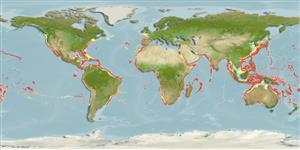
Tropical and warm temperate waters of all oceans, but absent from eastern Pacific except at Sala y Gomez Ridge.
Länge bei der ersten Reifung / Größe / Gewicht / Alter
Geschlechtsreife: Lm 47.4 range ? - ? cm
Max length : 100.0 cm SL Männchen/unbestimmt; (Ref. 6181); common length : 40.0 cm SL Männchen/unbestimmt; (Ref. 3403); max. veröff. Alter: 11 Jahre (Ref. 32115)
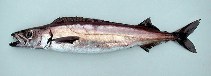
Rückenflossenstacheln (insgesamt) : 18 - 20; Rückenflossenweichstrahlen (insgesamt) : 17 - 20; Afterflossenstacheln: 2 - 3; Afterflossenweichstrahlen: 15 - 17. Body moderately elongate. Mouth with fang-like teeth. Spinescent gill rakers on the first arch with 1 - 3 cusps and many small spines; the angular raker long and triple-rooted. Body entirely scaled at over 20 - 25 cm SL. Pyloric caeca 7 or 8. Color is grayish to copper brown; fins blackish at over 40 cm SL, yellowish with black tips in smaller specimens (the first dorsal fin with a black blotch on two anteriormost membranes); the buccal and branchial cavities are black. Pelvic fin reduced to one spine that becomes entirely absent in specimens more than 40 cm SL.
Body shape (shape guide): elongated; Cross section: compressed.
Found at continental slopes, around oceanic islands and submarine rises (Ref. 6181). Meso-benthopelagic (Ref. 58302). Migrate to midwater at night (Ref. 6181). Feed on fish, cephalopods and crustaceans (Ref. 6181). Eggs and larvae are pelagic (Ref. 6766).
Probably spawns throughout the year in warmer seas.
Nakamura, I. and N.V. Parin, 1993. FAO Species Catalogue. Vol. 15. Snake mackerels and cutlassfishes of the world (families Gempylidae and Trichiuridae). An annotated and illustrated catalogue of the snake mackerels, snoeks, escolars, gemfishes, sackfishes, domine, oilfish, cutlassfishes,. scabbardfishes, hairtails, and frostfishes known to date. FAO Fish. Synop. 125(15):136 p. (Ref. 6181)
IUCN Rote Liste Status (Ref. 130435: Version 2025-2 (Global))
Bedrohung für Menschen
Reports of ciguatera poisoning (Ref. 31637)
Nutzung durch Menschen
Fischereien: kleinfischerei; Sportfisch: ja; Köder: usually
Tools
Zusatzinformationen
Download XML
Internet Quellen
Schätzungen auf der Grundlage von Modellen
Bevorzugte Temperatur (Ref.
123201): 8.6 - 16.5, mean 11.1 °C (based on 329 cells).
Phylogenetischer Diversitätsindex (Ref.
82804): PD
50 = 1.0000 [Uniqueness, from 0.5 = low to 2.0 = high].
Bayesian length-weight: a=0.00355 (0.00220 - 0.00572), b=3.07 (2.93 - 3.21), in cm total length, based on LWR estimates for this species & (Sub)family-body (Ref.
93245).
Trophische Ebene (Ref.
69278): 4.2 ±0.57 se; based on food items.
Widerstandsfähigkeit (Ref.
120179): niedrig, Verdopplung der Population dauert 4,5 - 14 Jahre. (K=0.17-0.18; tm=4; tmax=11;).
Anfälligkeit der Fischerei (Ref.
59153): High vulnerability (58 of 100).
🛈
Klimaanfälligkeit (Ref.
125649): Moderate vulnerability (39 of 100).
🛈
Nährstoffe (Ref.
124155): Calcium = 32.6 [15.0, 65.6] mg/100g; Iron = 0.62 [0.29, 1.21] mg/100g; Protein = 17.7 [15.6, 19.7] %; Omega3 = 0.255 [0.146, 0.444] g/100g; Selenium = 60.5 [27.5, 122.0] μg/100g; VitaminA = 12.2 [3.6, 42.3] μg/100g; Zinc = 0.55 [0.38, 0.82] mg/100g (wet weight);