Holocephali (chimeren) (chimaeras) >
Chimaeriformes (Chimaeras) >
Rhinochimaeridae (Longnose chimaeras)
Etymology: Harriotta: [an]a- (L.), belonging to: per Goode & Bean (1896), in honor of Thomas Harriott (ca. 1560‒1621), English astronomer, mathematician, ethnographer and translator, who published the first English work on American natural history (1588) (See ETYFish); raleighana: In honor of Sir Walter Raleigh (ca. 1554‒1618), “philosopher and explorer, by whom the first English scientific expedition was sent to the New World” (Raleigh funded a 1585 expedition to Roanoke Island, North Carolina, with Thomas Harriott [honored in the (See ETYFish).
Eponymy: Thomas Harriott (ca: 1560–1621) was an English astronomer, mathematician, ethnographer and translator, who published first English work on American natural history (1588). [...] Sir Walter Raleigh (ca: 1554–1618), the English explorer, writer, poet, soldier and spy, needs no long biography here. The authors say of him: “…by whom the first English scientific expedition was sent to the New World.” (Ref. 128868), visit book page.
More on authors: Goode & Bean.
Milieu: milieu / Klimaatzone / Diepte / verspreidingsgebied
Ecologie
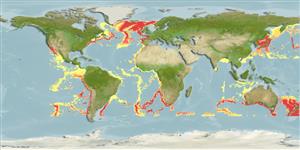
marien bathydemersaal; diepte 200 - 3100 m (Ref. 117245), usually 500 - 2000 m (Ref. 97389). Deep-water; 65°N - 49°S, 121°W - 179°E
Circumglobal.
Lengte bij maturiteit / Grootte / Gewicht / Leeftijd
Maturiteit: Lm 75.8, range 66 - 84.3 cm
Max length : 120 cm OT mannelijk / geslacht onbekend; (Ref. 26346); 102.5 cm TL (female); max. gepubliceerd gewicht: 1.6 kg (Ref. 122636)
Korte beschrijving
Determinatiesleutels | Morfologie | Morfometrie
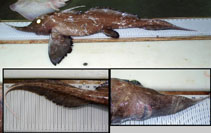
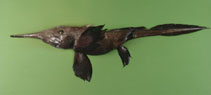
This species is distinguished from H. chaetirhampha by the following characters: H. raleighana with eye small, its length 7% BDL (vs. 7-9% in H. chaetirhampha); interorbital space broad, 11-16% BDL (vs. 6-9%); snout tip smooth (vs. armed with small knob-like projections; only prominent in male); first dorsal fin low, length of dorsal spine anterior margin 16% BDL (vs. 19-24%); pectoral and pelvic fins broadly rounded (vs. bluntly
pointed); interdorsal space narrow, 4.5-8.4% BDL (vs. 24.8-26.8%); length of caudal dorsal margin (CDM) longer (vs. shorter) than caudal ventral margin, CDM 74-79% BDL (vs. 49-62%); length of caudal upper ray (CUR) longer (vs. shorter) than that of lower ray, CUR 10-11% BDL (vs. 4-5%); infraorbital canal strongly curved anterior to eye, forming S-shaped loop (vs. only gently curved); with distinct longer and thicker claspers, its outer length 25% BDL (vs. 16%) and its base width 3% BDL (vs. 1%); tip of the clasper excessively inflated so as to form a large, elongate and fleshy knob, covered with 16 (17 in right side) small, multifaceted, hemp-leaf shaped spines, most of which were serially arranged along its dorsomesial margin (vs. small bulb, with several simple spines sparsely distributed); a deep slit running longitudinally from dorsolateral base of rod to the ventromesial surface of the knob, running along the dorsal side of the clasper( vs. not prominent) (Ref. 123553).
Cross section: angular.
Found on the continental slope and ocean floor (Ref. 26346). Appears to feed mainly on shellfish and crustaceans (Ref. 6871). Maximum length 120 cm without tail filament (Ref. 26346). It is captured as by-catch in deep water trawl fisheries (Ref. 117245).
Oviparous, young hatch at about 10-13 cm (Ref. 26346).
Last, P.R. and J.D. Stevens, 1994. Sharks and rays of Australia. CSIRO, Australia. 513 p. (Ref. 6871)
Status op de Rode Lijst van het IUCN (Ref. 130435: Version 2025-2 (Global))
Gevaar voor de mens
Harmless
Gebruik door de mens
Visserij: van geen belang
Tools
Speciale rapporten
Download XML
Internetbronnen
Schattingen op basis van modellen
Gewenste temperatuur (Ref.
123201): 0.3 - 9, mean 5.2 °C (based on 654 cells).
Fylogenetische diversiteitsindex (Ref.
82804): PD
50 = 0.6270 [Uniqueness, from 0.5 = low to 2.0 = high].
Bayesian length-weight: a=0.00162 (0.00122 - 0.00216), b=3.15 (3.07 - 3.23), in cm total length, based on LWR estimates for this species (Ref.
93245).
Trofisch niveau (Ref.
69278): 3.6 ±0.38 se; based on food items.
Weerstandsvermogen (Ref.
120179): laag, minimale populatieverdubbelingstijd 4,5-14 jaar (Assuming Fec <100).
Kwetsbaarheid van de visserij (Ref.
59153): Moderate to high vulnerability (48 of 100).
🛈
Voedingsstoffen (Ref.
124155): Calcium = 9.59 [2.75, 33.16] mg/100g; Iron = 0.372 [0.123, 0.947] mg/100g; Protein = 14.1 [9.7, 18.1] %; Omega3 = 0.294 [0.107, 0.810] g/100g; Selenium = 23.6 [7.1, 77.7] μg/100g; VitaminA = 5.9 [1.2, 26.0] μg/100g; Zinc = 0.308 [0.158, 0.601] mg/100g (wet weight);