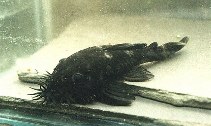
Taxonomic Remarks
12S and 16S mitochondrial rRNA gene sequences used in molecular phylogenies by Montoya-Burgos et al. (1997: fig. 4; 1998: figs. 3 & 6; EMBL/GenBank Y08280; Y08328).
Entorno: milieu / zona climática / rango de profundidad / gama de distribución
Ecología
; agua dulce demersal. Subtropical; 25°C - 28°C (Ref. 13614)
South America: Xingu and Tocantins River basins in Brazil.
Tamaño / Peso / Edad
Madurez: Lm ? range ? - ? cm
Max length : 19.5 cm TL macho / no sexado; (Ref. 111518); peso máximo publicado: 153.67 g (Ref. 111518)
Facultative or obligate air-breathing (Ref. 126274); Inhabits clear running water, without a strong current to a depth of 3 meters during dry season. Prefers narrow cracks of submerged rocks, small passages between superimposed rocks, or lives below flat rocks on the bottom.
Ciclo vital y comportamiento de apareamiento
Madurez | Reproducción | Puesta | Huevos | Fecundidad | Larva
Muller, S., L.H. Rapp Py-Daniel and J. Zuanon, 1994. Ancistrus ranunculus, a new species of loricariidae fish (Siluriformes: Loricariidae) from the Xingu and Tocantins rivers, Brazil. Ichthyol. Explor. Freshwat. 5(4):289-296. (Ref. 26707)
Situación en la Lista Roja de la UICN (Ref. 130435: Version 2025-2 (Global))
Amenaza para el ser humano
Harmless
Usos humanos
Pesquerías: sin interés
Herramientas
Informes especiales
Descargar XML
Fuentes de Internet
Estimaciones basadas en modelos
Índice de diversidad filogenética (Referencia
82804): PD
50 = 0.5000 [Uniqueness, from 0.5 = low to 2.0 = high].
Bayesian length-weight: a=0.01479 (0.00772 - 0.02833), b=3.04 (2.88 - 3.20), in cm total length, based on LWR estimates for this species & Genus-body shape (Ref.
93245).
Resiliencia (Referencia
120179): Medio, población duplicada en un tiempo mínimo de 1.4-4.4 años (Preliminary K or Fecundity.).
Vulnerabilidad pesquera (Ref.
59153): Low vulnerability (10 of 100).
🛈