Ambiente: milieu / zona climatica / distribuzione batimetrica / gamma di distribuzione
Ecologia
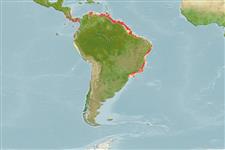
marino; acqua dolce; salmastro pelagic-neritic; distribuzione batimetrica 1 - 55 m, usually 5 - 30 m (Ref. 9298). Tropical; 14°N - 26°S, 87°W - 32°W (Ref. 189)
Western Atlantic: Panama to Trinidad and south to at least Santos, Brazil, perhaps further. Eastern Pacific: Costa Rica to the northern border of Peru at 3°34'S, perhaps further. Also found in freshwater.
Dimensione / Peso / Età
Maturità: Lm ? range ? - ? cm
Max length : 24.0 cm TL maschio/sesso non determinato; (Ref. 5217); common length : 20.0 cm TL maschio/sesso non determinato; (Ref. 5217); peso massimo pubblicato: 66.30 g (Ref. 118626)
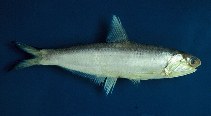
Spine dorsali (totale) : 0; Spine anali: 0; Raggi anali molli: 31 - 37. Snout about 3/4 eye diameter; maxilla long, tip pointed, reaching to or a little beyond edge of gill cover; anterior gill rakers mere stumps; hind border of gill cover with a small triangular projection; panamensis-type gill cover canals. Pectoral fin long; anal fin origin below midpoint of dorsal fin base. A silver stripe along flank in small individuals, disappearing with age (Ref. 189).
Body shape (shape guide): elongated; Cross section: oval.
A coastal species that apparently forms large schools. Enters brackish and fresh waters. Feeds on small fishes (including clupeoids) and prawns (Ref. 12225). Seems to spawn over an extended period in Costa Rica (small fishes caught in February, September and October). Marketed fresh (Ref. 9298).
Ciclo vitale e comportamento di accoppiamento
Maturità | Riproduzione | Deposizione | Uova | Fecondità | Larve
Probably an extended spawning season in Costa Rica (small fishes caught in February, September and October (Ref. 189). Spawn in school (Ref. 205).
Whitehead, P.J.P., G.J. Nelson and T. Wongratana, 1988. FAO Species Catalogue. Vol. 7. Clupeoid fishes of the world (Suborder Clupeoidei). An annotated and illustrated catalogue of the herrings, sardines, pilchards, sprats, shads, anchovies and wolf-herrings. FAO Fish. Synop. 125(7/2):305-579. Rome: FAO. (Ref. 189)
Stato della Lista Rossa IUCN (Ref. 130435: Version 2025-2 (Global))
Minaccia per l'uomo
Harmless
Usi umani
Pesca: scarso interesse commerciale
Strumenti
Rapporti speciali
Scarica XML
Fonti Internet
Stime basate su modelli
Temperatura preferita (Fonte Biblio.
123201): 25.2 - 28.2, mean 27.4 °C (based on 122 cells).
Indice di diversità filogenetica (Fonte Biblio.
82804): PD
50 = 0.5000 [Uniqueness, from 0.5 = low to 2.0 = high].
Bayesian length-weight: a=0.00447 (0.00290 - 0.00687), b=3.17 (3.04 - 3.30), in cm total length, based on LWR estimates for this species & Genus-body shape (Ref.
93245).
Livello trofico (Fonte Biblio.
69278): 4.1 ±0.71 se; based on food items.
Resilienza (Fonte Biblio.
120179): Alto, tempo minimo di raddoppiamento della popolazione meno di 15 mesi (Preliminary K or Fecundity.).
Vulnerabilità della pesca (Ref.
59153): Low vulnerability (14 of 100).
🛈
Nutrienti (Ref.
124155): Calcium = 188 [109, 440] mg/100g; Iron = 1.38 [0.74, 2.46] mg/100g; Protein = 17.8 [15.4, 20.5] %; Omega3 = 0.338 [0.163, 0.725] g/100g; Selenium = 40.5 [18.0, 103.2] μg/100g; VitaminA = 19.3 [5.6, 54.8] μg/100g; Zinc = 1.51 [1.04, 2.18] mg/100g (wet weight);