Lớp phụ Cá sụn (cá mập và cá đuối) (sharks and rays) >
Squatiniformes (Angel sharks) >
Squatinidae (Angel sharks)
Etymology: Squatina: Latin for skate, which angel sharks superficially resemble, presumably tautonymous with Squalus squatina Linnaeus 1758 (no species mentioned) (See ETYFish); occulta: Latin for hidden or concealed, referring to its identity having remained hidden among a group of morphologically similar sympatric species (See ETYFish).
Môi trường: môi trường / vùng khí hậu / Mức độ sâu / phạm vi phân phối
Sinh thái học
biển gần đáy. Subtropical; 19°S - 34°S (Ref. 95520)
Southwest Atlantic: southern Brazil to southern Uruguay.
Bộ gần gũi / Khối lượng (Trọng lượng) / Tuổi
Chín muồi sinh dục: Lm ? range ? - ? cm
Max length : 156.0 cm TL (female)
Mô tả ngắn gọn
Khóa để định loại | Hình thái học | Sinh trắc học
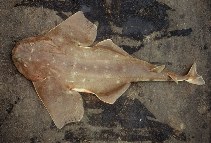
This species is distinguished by its unique dorsal color pattern, with a uniform light to dark brown background color, with numerous white to yellowish rounded, small spots on entire dorsal surface, some surrounded by many small black spots, forming irregular ocelli-like markings; differs from S. guggenheim by the smaller and more numerous white spots on entire dorsal surface, spot size one-half to eye-length (vs. less numerous spots about equal to eye to 1.5 eye-length in S. guggenheim), larger size at maturity > 100.0 cm (vs. 73.0-80.0 cm), dermal denticles over pectoral fins morphologically homogeneous, no sort of enlarged dermal denticle present (vs. a pair or more of enlarged dermal denticles close to dorsal pectoral origin), the dorsal midline with denticles morphologically similar to trunk denticles, or denticles over dorsal midline posterior to pectoral insertion slightly enlarged, the basal plate 1.5-2 times diameter of other dorsal denticles and organized in a row in some juveniles of S. occulta (vs. a row of enlarged, conical denticles over dorsal midline, morphologically distinct from other dorsal denticles, with basal plate 3-4 times that of other dorsal denticles, and a crown with several median ridges and acute non-ridged apex); differs from S. argentina by having a lighter background color, light to dark brown (vs. dark brown to reddish-brown), with a pair of enlarged, conical and morphologically distinct dermal denticles between spiracles, the basal plate 3-4 times diameter of other denticles, crown with several median ridges, and smooth and acute crown apex (vs. interspiracular surface covered by smaller dorsal denticles, without enlarged denticles), with lower number of tooth rows, 18-0 longitudinal tooth rows on upper jaw and 18-2 tooth rows on lower jaw, tooth formula: 9-9 to 10-10/9-9 to 11-11 (vs. 12-12/12-12 in S. argentina), and in almost all specimens, by anterior margin of pectoral fin straight to slightly convex (vs. anterior margin of pectoral fin convex in S. argentina) (Ref. 95520).
Cross section: angular.
Ovoviviparous (Ref. 50449). Max. length (Alfredo Carvalho Filho, pers. comm., 2002).
Vòng đời và hành vi giao phối
Chín muồi sinh dục | Sự tái sinh sản | Đẻ trứng | Các trứng | Sự sinh sản | Ấu trùng
Ovoviviparous, embryos feed solely on yolk (Ref. 50449).
Vaz, D.F.B. and M.R. De Carvalho, 2013. Morphological and taxonomic revision of species of Squatina from the Southwestern Atlantic Ocean (Chondrichthyes: Squatiniformes: Squatinidae). Zootaxa 3695(1):001-081. (Ref. 95520)
Tình trạng Sách đỏ IUCN (Ref. 130435: Version 2025-2 (Global))
Mối đe dọa đối với con người
Harmless
Sử dụng của con người
Các công cụ
Báo cáo đặc biệt
Tải xuống XML
Các nguồn internet
Ước tính dựa trên mô hình
Chỉ số đa dạng phát sinh loài (Tài liệu tham khảo
82804): PD
50 = 0.5000 [Uniqueness, from 0.5 = low to 2.0 = high].
Bayesian length-weight: a=0.00661 (0.00287 - 0.01523), b=3.07 (2.88 - 3.26), in cm total length, based on LWR estimates for this Genus-body shape (Ref.
93245).
Mức dinh dưỡng (Tài liệu tham khảo
69278): 4.1 ±0.6 se; based on size and trophs of closest relatives
Thích nghi nhanh (Tài liệu tham khảo
120179): thấp, thời gian nhân đôi của chủng quần tối thiểu là 4.5 - 14 năm (Fec assumed to be <100).
Sự dễ bị tổn thương của nghề đánh cá (Ref.
59153): Very high vulnerability (90 of 100).
🛈