(كوسه ها و سپرماهيان) (sharks and rays) >
Myliobatiformes (Stingrays) >
Dasyatidae (Stingrays) > Urogymninae
Etymology: Urogymnus: Greek, oura = tail + Greek, gymnos = naked (Ref. 45335).
More on authors: Bloch & Schneider.
Taxonomic Remarks
Urogymnus africanus and Urogymnus asperrimus are considered synonyms and both are originally described in the same work. There is uncertainty about which name has priority, and thus both names can be found as valid; the first reviser is not researched (Eschmeyer, 2014).
محیط زیست: محیط زیست / منطقه آب و هوایی / تغييرات عمق / محدوده توزیع
بوم شناسي
دريايي; لب شور وابسته به آب سنگ; تغييرات عمق 15 - 217 m (Ref. 86942). Tropical; 31°N - 31°S, 20°W - 177°W
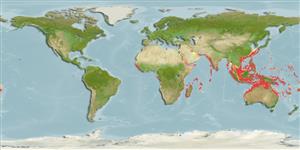
Eastern Central Atlantic: Senegal, Guinea, and Côte d'Ivoire (Ref. 4438). Indo-Pacific: Red Sea and coast of East Africa to the Marshall Islands and Fiji, south to northern Australia (Ref. 2334).
طول در اولین بلوغ / اندازه / وزن / سن
بلوغ: Lm ?, range 100 - ? cm
Max length : 147 cm WD جنس نر / بدون خواص جنسي; (Ref. 58048)
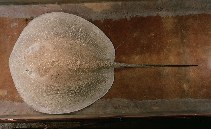
Diagnosis: A heavily armored stingray lacking a venomous barb; young with large, flat denticles on upper surface, and large juveniles and adults with additional sharp conical thorns and small, pointed denticles (Ref. 5578).
Body shape (shape guide): other.
Inhabits the continental shelf area (Ref. 2334), but capable of entering coastal lagoons (Ref. 81259). Found on sand and coral rubble areas near reefs (Ref. 9840), often in caves. Ovoviviparous (Ref. 50449). Due to its difficult handling, it is probably of limited commercial value (Ref. 9840). Its thorn can inflict a painful injury; caught commonly by demersal tangle net fisheries; utilized for its meat, skin (very high value) and cartilage (Ref.58048).
چرخه زندگی و رفتار جفتگیری
بلوغ | تولید مثل | تخم ریزی | تخم ها | باروری | توزاد ( لارو)
Exhibit ovoviparity (aplacental viviparity), with embryos feeding initially on yolk, then receiving additional nourishment from the mother by indirect absorption of uterine fluid enriched with mucus, fat or protein through specialised structures (Ref. 50449). Distinct pairing with embrace (Ref. 205). Distinct pairing with embrace (Ref. 205).
Randall, J.E., G.R. Allen and R.C. Steene, 1990. Fishes of the Great Barrier Reef and Coral Sea. University of Hawaii Press, Honolulu, Hawaii. 506 p. (Ref. 2334)
وضعيت در فهرست قرمز IUCN (Ref. 130435: Version 2025-2 (Global))
خطر برای انسان ها
Traumatogenic (Ref. 2334)
استفاده انسانی
ماهي گيري – شيلات: تجاري
ابزارها
گزارش های ويژه
بارگيری XML
منابع اينترنتي
تخمینها بر اساس مدلها
دمای ترجیحی (مرجع
123201): 25.4 - 29.3, mean 28.5 °C (based on 2874 cells).
شاخص تنوع فیلوژنتیکی (مرجع
82804): PD
50 = 0.5156 [Uniqueness, from 0.5 = low to 2.0 = high].
Bayesian length-weight: a=0.01023 (0.00482 - 0.02174), b=3.06 (2.86 - 3.26), in cm total length, based on LWR estimates for this (Sub)family-body shape (Ref.
93245).
سطح تروفیک (مرجع
69278): 3.5 ±0.46 se; based on food items.
جهندگی (مرجع
120179): پايين ، كم, كمينه زمان لازم براي دو برابر شدن جمعيت 5/4 – 14 سال (Assuming fecundity<100).
آسیبپذیری ماهیگیری (Ref.
59153): Very high vulnerability (90 of 100).
🛈
مواد مغذی (Ref.
124155): Calcium = 5.12 [0.57, 77.92] mg/100g; Iron = 0.354 [0.028, 3.818] mg/100g; Protein = 21.4 [18.7, 24.1] %; Omega3 = 0.0888 [, ] g/100g; Selenium = 41.6 [7.4, 202.0] μg/100g; VitaminA = 20.7 [1.8, 237.0] μg/100g; Zinc = 0.791 [0.052, 9.041] mg/100g (wet weight);