Taxonomic Remarks
Urogymnus africanus and Urogymnus asperrimus are considered synonyms and both are originally described in the same work. There is uncertainty about which name has priority, and thus both names can be found as valid; the first reviser is not researched (Eschmeyer, 2014).
環境:環境 / 気候帯 / 深さの範囲 / 分布範囲
生態学
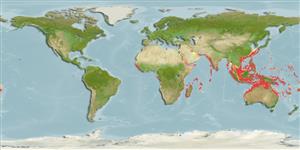
海; 汽水性の 関連する礁; 深さの範囲 15 - 217 m (Ref. 86942). Tropical; 31°N - 31°S, 20°W - 177°W
Eastern Central Atlantic: Senegal, Guinea, and Côte d'Ivoire (Ref. 4438). Indo-Pacific: Red Sea and coast of East Africa to the Marshall Islands and Fiji, south to northern Australia (Ref. 2334).
初回成熟時の長さ / サイズ / 重さ / 年齢
成熟: Lm ?, range 100 - ? cm
Max length : 147 cm WD オス/雌雄の選別がない; (Ref. 58048)
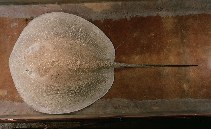
Diagnosis: A heavily armored stingray lacking a venomous barb; young with large, flat denticles on upper surface, and large juveniles and adults with additional sharp conical thorns and small, pointed denticles (Ref. 5578).
Body shape (shape guide): other.
Inhabits the continental shelf area (Ref. 2334), but capable of entering coastal lagoons (Ref. 81259). Found on sand and coral rubble areas near reefs (Ref. 9840), often in caves. Ovoviviparous (Ref. 50449). Due to its difficult handling, it is probably of limited commercial value (Ref. 9840). Its thorn can inflict a painful injury; caught commonly by demersal tangle net fisheries; utilized for its meat, skin (very high value) and cartilage (Ref.58048).
ライフサイクルと交尾行動
成熟 | 繁殖 | 放精 | 卵 | 生産力 | 幼生
Exhibit ovoviparity (aplacental viviparity), with embryos feeding initially on yolk, then receiving additional nourishment from the mother by indirect absorption of uterine fluid enriched with mucus, fat or protein through specialised structures (Ref. 50449). Distinct pairing with embrace (Ref. 205). Distinct pairing with embrace (Ref. 205).
Randall, J.E., G.R. Allen and R.C. Steene, 1990. Fishes of the Great Barrier Reef and Coral Sea. University of Hawaii Press, Honolulu, Hawaii. 506 p. (Ref. 2334)
IUCNのレッドリストの状況は (Ref. 130435: Version 2025-2 (Global))
絶滅危惧 (EN) (A2cd); Date assessed: 16 June 2023
人間に対する脅威
Traumatogenic (Ref. 2334)
人間の用途
水産業: 商業
用具
特記事項
XMLをダウンロードして下さい
インターネットの情報源
モデルに基づく推定値
好ましい温度 (参照
123201): 25.4 - 29.3, mean 28.5 °C (based on 2874 cells).
系統多様性指数 (参照
82804): PD
50 = 0.5156 [Uniqueness, from 0.5 = low to 2.0 = high].
Bayesian length-weight: a=0.01023 (0.00482 - 0.02174), b=3.06 (2.86 - 3.26), in cm total length, based on LWR estimates for this (Sub)family-body shape (Ref.
93245).
栄養段階 (参照
69278): 3.5 ±0.46 se; based on food items.
回復力 (参照
120179): 低い, 4.5年~14年の倍増期間の最小個体群 (Assuming fecundity<100).
漁業の脆弱性 (Ref.
59153): Very high vulnerability (90 of 100).
🛈
栄養素 (Ref.
124155): Calcium = 5.12 [0.57, 77.92] mg/100g; Iron = 0.354 [0.028, 3.818] mg/100g; Protein = 21.4 [18.7, 24.1] %; Omega3 = 0.0888 [, ] g/100g; Selenium = 41.6 [7.4, 202.0] μg/100g; VitaminA = 20.7 [1.8, 237.0] μg/100g; Zinc = 0.791 [0.052, 9.041] mg/100g (wet weight);