Élasmobranches (requins et raies) (sharks and rays) >
Carcharhiniformes (Ground sharks) >
Atelomycteridae (Coloured catsharks)
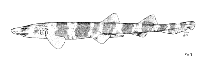
Etymology: Atelomycterus: ateles (Gr.), imperfect, unfilled or exempt; mycteros (Gr.), nostril, referring to lack of posterior nasal valve (See ETYFish); fasciatus: Latin for banded, referring to slender, brown saddles on a white background (See ETYFish).
Environnement : milieu / zone climatique / profondeur / gamme de distribution
Écologie
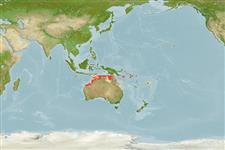
marin démersal; profondeur 27 - 122 m (Ref. 11146), usually ? - 60 m (Ref. 11146). Tropical; 10°S - 21°S
Indo-West Pacific: northern Australia. Western Australian specimens lack the white spots and are lighter colored.
Longueur à la première maturité / Taille / Poids / Âge
Maturité: Lm 34.5, range 30 - 39 cm
Max length : 45.0 cm TL mâle / non sexé; (Ref. 11146)
Épines dorsales (Total) : 0; Épines anales: 0. Black spots and markings relatively few, small, and scattered, color pattern dominated by greyish saddles and bands on light background (Ref. 11146). Western Australian specimens lack the white spots and are lighter in color (Ref. 11146).
Body shape (shape guide): elongated.
A common offshore catshark found on mud, sand, or shelly-sand bottom (Ref. 11146). Oviparous (Ref. 50449).
Cycle de vie et comportement reproducteur
Maturité | Reproduction | Frai | Œufs | Fécondité | Larves
Oviparous, paired eggs are laid. Embryos feed solely on yolk (Ref. 50449).
Compagno, L.J.V. and V.H. Niem, 1998. Scyliorhinidae. Catsharks. p. 1279-1292. In K.E. Carpenter and V.H. Niem (eds.) FAO Identification Guide for Fishery Purposes. The Living Marine Resources of the Western Central Pacific Vol. 2. Rome: FAO. (Ref. 11146)
Statut dans la liste rouge de l'IUCN (Ref. 130435: Version 2025-2 (Global))
Menace pour l'homme
Harmless
Utilisations par l'homme
Outils
Articles particuliers
Télécharger en XML
Sources Internet
Estimations basées sur des modèles
Température préférée (Réf.
123201): 25.3 - 28.3, mean 26.6 °C (based on 22 cells).
Indice de diversité phylogénétique (Réf.
82804): PD
50 = 0.5157 [Uniqueness, from 0.5 = low to 2.0 = high].
Bayesian length-weight: a=0.00389 (0.00180 - 0.00842), b=3.12 (2.94 - 3.30), in cm total length, based on all LWR estimates for this body shape (Ref.
93245).
Niveau trophique (Réf.
69278): 3.7 ±0.3 se; based on size and trophs of closest relatives
Résilience (Réf.
120179): Faible, temps minimum de doublement de population : 4,5 à 14 années (Fec assumed to be <100).
Vulnérabilité de la pêche (Ref.
59153): Low to moderate vulnerability (35 of 100).
🛈