Elasmobranquios (tiburones y rayas) (sharks and rays) >
Carcharhiniformes (Ground sharks) >
Atelomycteridae (Coloured catsharks)
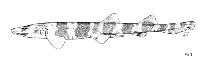
Etymology: Atelomycterus: ateles (Gr.), imperfect, unfilled or exempt; mycteros (Gr.), nostril, referring to lack of posterior nasal valve (See ETYFish); fasciatus: Latin for banded, referring to slender, brown saddles on a white background (See ETYFish).
Entorno: milieu / zona climática / rango de profundidad / gama de distribución
Ecología
marino demersal; rango de profundidad 27 - 122 m (Ref. 11146), usually ? - 60 m (Ref. 11146). Tropical; 10°S - 21°S
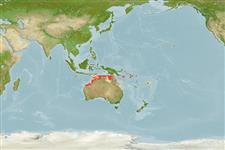
Indo-West Pacific: northern Australia. Western Australian specimens lack the white spots and are lighter colored.
Longitud en la primera madurez / Tamaño / Peso / Edad
Madurez: Lm 34.5, range 30 - 39 cm
Max length : 45.0 cm TL macho / no sexado; (Ref. 11146)
Espinas dorsales (total) : 0; Espinas anales: 0. Black spots and markings relatively few, small, and scattered, color pattern dominated by greyish saddles and bands on light background (Ref. 11146). Western Australian specimens lack the white spots and are lighter in color (Ref. 11146).
Body shape (shape guide): elongated.
A common offshore catshark found on mud, sand, or shelly-sand bottom (Ref. 11146). Oviparous (Ref. 50449).
Ciclo vital y comportamiento de apareamiento
Madurez | Reproducción | Puesta | Huevos | Fecundidad | Larva
Oviparous, paired eggs are laid. Embryos feed solely on yolk (Ref. 50449).
Compagno, L.J.V. and V.H. Niem, 1998. Scyliorhinidae. Catsharks. p. 1279-1292. In K.E. Carpenter and V.H. Niem (eds.) FAO Identification Guide for Fishery Purposes. The Living Marine Resources of the Western Central Pacific Vol. 2. Rome: FAO. (Ref. 11146)
Situación en la Lista Roja de la UICN (Ref. 130435: Version 2025-2 (Global))
Amenaza para el ser humano
Harmless
Usos humanos
Herramientas
Informes especiales
Descargar XML
Fuentes de Internet
Estimaciones basadas en modelos
Temperatura preferida (Referencia
123201): 25.3 - 28.3, mean 26.6 °C (based on 22 cells).
Índice de diversidad filogenética (Referencia
82804): PD
50 = 0.5157 [Uniqueness, from 0.5 = low to 2.0 = high].
Bayesian length-weight: a=0.00389 (0.00180 - 0.00842), b=3.12 (2.94 - 3.30), in cm total length, based on all LWR estimates for this body shape (Ref.
93245).
Nivel trófico (Referencia
69278): 3.7 ±0.3 se; based on size and trophs of closest relatives
Resiliencia (Referencia
120179): Bajo, población duplicada en un tiempo mínimo de 4.5-14 años (Fec assumed to be <100).
Vulnerabilidad pesquera (Ref.
59153): Low to moderate vulnerability (35 of 100).
🛈