Elasmobranchi (squali e razze) (sharks and rays) >
Myliobatiformes (Stingrays) >
Gymnuridae (Butterfly rays)
Etymology: Gymnura: Greek, gymnos = naked + Greek, oura = tail (Ref. 45335).
More on authors: Gilchrist & Thompson.
Ambiente: milieu / zona climatica / distribuzione batimetrica / gamma di distribuzione
Ecologia
marino demersale; distribuzione batimetrica 20 - 100 m (Ref. 28016). Subtropical
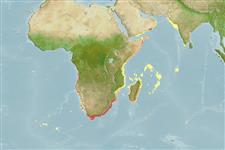
Southeast Atlantic and Western Indian Ocean: Namibia round the Cape to southern Mozambique.
Lunghezza alla prima maturità / Dimensione / Peso / Età
Maturità: Lm ?, range 150 - ? cm
Max length : 250 cm WD maschio/sesso non determinato; (Ref. 3263); peso massimo pubblicato: 82.6 kg (Ref. 40637)
Breve descrizione
Chiavi di identificazione | Morfologia | Morfometria
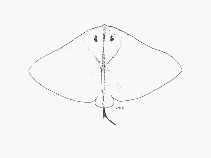
Spine dorsali (totale) : 0. Broad diamond-shaped pectoral disc almost twice as wide as it is long; tail shorter than body with black and white bands and a small sting; tentacle at rear edge of each spiracle (Ref. 5578). Grey, green or brown above, often with darker mottling; white below; can change color of upper disc rapidly to match substrate (Ref. 5578).
Body shape (shape guide): other.
Occurs off sandy beaches, muddy estuaries and offshore banks. Found singly or in large groups (Ref. 5578). Feeds on a variety of fishes, crabs and polychaete worms (Ref. 5578). Ovoviviparous (Ref. 50449). Ability to change markings and color to blend into environment (Ref. 3263). Caught by offshore trawlers (Ref. 5578). Caught by shore anglers, it is prized for its strong fight when hooked, often released (Ref. 5578).
Exhibit ovoviparity (aplacental viviparity), with embryos feeding initially on yolk, then receiving additional nourishment from the mother by indirect absorption of uterine fluid enriched with mucus, fat or protein through specialised structures (Ref. 50449). Distinct pairing with embrace (Ref. 205). One year gestation; up to 10 young (Ref. 5578).
Compagno, L.J.V., 1986. Dasyatidae. p. 135-142. In M.M. Smith and P.C. Heemstra (eds.) Smiths' sea fishes. Springer-Verlag, Berlin. (Ref. 3263)
Stato della Lista Rossa IUCN (Ref. 130435: Version 2025-2 (Global))
Minaccia per l'uomo
Harmless
Usi umani
Pesca: bycatch; Pesce da pesca sportiva: si
Strumenti
Rapporti speciali
Scarica XML
Fonti Internet
Stime basate su modelli
Temperatura preferita (Fonte Biblio.
123201): 14.5 - 27.1, mean 25.3 °C (based on 72 cells).
Indice di diversità filogenetica (Fonte Biblio.
82804): PD
50 = 0.5000 [Uniqueness, from 0.5 = low to 2.0 = high].
Bayesian length-weight: a=0.00851 (0.00393 - 0.01841), b=3.08 (2.88 - 3.28), in cm total length, based on LWR estimates for this (Sub)family-body shape (Ref.
93245).
Livello trofico (Fonte Biblio.
69278): 3.9 ±0.65 se; based on food items.
Resilienza (Fonte Biblio.
120179): Molto basso, tempo minimo di raddoppiamento della popolazione più di 14 anni (Fec=10).
Vulnerabilità della pesca (Ref.
59153): Moderate vulnerability (43 of 100).
🛈