Elasmobranquios (tiburones y rayas) (sharks and rays) >
Myliobatiformes (Stingrays) >
Gymnuridae (Butterfly rays)
Etymology: Gymnura: Greek, gymnos = naked + Greek, oura = tail (Ref. 45335).
More on authors: Gilchrist & Thompson.
Entorno: milieu / zona climática / rango de profundidad / gama de distribución
Ecología
marino demersal; rango de profundidad 20 - 100 m (Ref. 28016). Subtropical
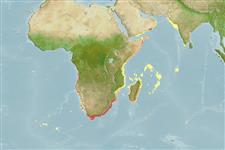
Southeast Atlantic and Western Indian Ocean: Namibia round the Cape to southern Mozambique.
Longitud en la primera madurez / Tamaño / Peso / Edad
Madurez: Lm ?, range 150 - ? cm
Max length : 250 cm WD macho / no sexado; (Ref. 3263); peso máximo publicado: 82.6 kg (Ref. 40637)
Descripción breve
Claves de identificación | Morfología | Morfometría
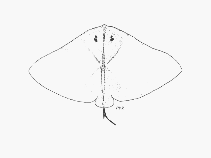
Espinas dorsales (total) : 0. Broad diamond-shaped pectoral disc almost twice as wide as it is long; tail shorter than body with black and white bands and a small sting; tentacle at rear edge of each spiracle (Ref. 5578). Grey, green or brown above, often with darker mottling; white below; can change color of upper disc rapidly to match substrate (Ref. 5578).
Body shape (shape guide): other.
Occurs off sandy beaches, muddy estuaries and offshore banks. Found singly or in large groups (Ref. 5578). Feeds on a variety of fishes, crabs and polychaete worms (Ref. 5578). Ovoviviparous (Ref. 50449). Ability to change markings and color to blend into environment (Ref. 3263). Caught by offshore trawlers (Ref. 5578). Caught by shore anglers, it is prized for its strong fight when hooked, often released (Ref. 5578).
Exhibit ovoviparity (aplacental viviparity), with embryos feeding initially on yolk, then receiving additional nourishment from the mother by indirect absorption of uterine fluid enriched with mucus, fat or protein through specialised structures (Ref. 50449). Distinct pairing with embrace (Ref. 205). One year gestation; up to 10 young (Ref. 5578).
Compagno, L.J.V., 1986. Dasyatidae. p. 135-142. In M.M. Smith and P.C. Heemstra (eds.) Smiths' sea fishes. Springer-Verlag, Berlin. (Ref. 3263)
Situación en la Lista Roja de la UICN (Ref. 130435: Version 2025-2 (Global))
Amenaza para el ser humano
Harmless
Usos humanos
Pesquerías: bycatch; pesca deportiva: si
Herramientas
Informes especiales
Descargar XML
Fuentes de Internet
Estimaciones basadas en modelos
Temperatura preferida (Referencia
123201): 14.5 - 27.1, mean 25.3 °C (based on 72 cells).
Índice de diversidad filogenética (Referencia
82804): PD
50 = 0.5000 [Uniqueness, from 0.5 = low to 2.0 = high].
Bayesian length-weight: a=0.00851 (0.00393 - 0.01841), b=3.08 (2.88 - 3.28), in cm total length, based on LWR estimates for this (Sub)family-body shape (Ref.
93245).
Nivel trófico (Referencia
69278): 3.9 ±0.65 se; based on food items.
Resiliencia (Referencia
120179): Muy bajo, población duplicada en un tiempo mínimo superior a 14 años (Fec=10).
Vulnerabilidad pesquera (Ref.
59153): Moderate vulnerability (43 of 100).
🛈