分類 / 名前
共通名の | 類義語 | Catalog of Fishes(部類, 種) | ITIS | CoL | WoRMS | Cloffa
>
Eupercaria/misc (Various families in series Eupercaria) >
Labridae (Wrasses) > Scarinae
Etymology: Chlorurus: Greek, chloros = green + Greek oura = tail (Ref. 45335).
More on author: Forsskål.
環境:環境 / 気候帯 / 深さの範囲 / 分布範囲
生態学
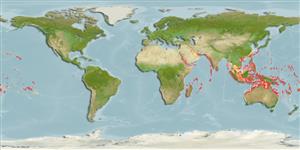
海; 汽水性の 関連する礁; 海洋回遊性 (Ref. 51243); 深さの範囲 0 - 50 m (Ref. 5213). Tropical; 30°N - 33°S, 30°E - 130°W
Indian Ocean.
初回成熟時の長さ / サイズ / 重さ / 年齢
成熟: Lm 15.0 range ? - ? cm
Max length : 40.0 cm TL オス/雌雄の選別がない; (Ref. 2334)
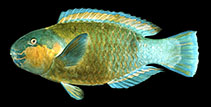
背面の脊椎 (合計) : 9; 背鰭 (合計) : 10; 肛門の骨: 3; 臀鰭: 9. Initial phase very variable in coloration. Small individuals may be uniformly dark brown to light gray with or without the dark-centered light area on the caudal peduncle; large individuals may have a series of irregular rows of small light spots posteriorly or have the dark-centered light area on the caudal peduncle. The terminal phase is also variable with or without a large tan area on the side or on the caudal peduncle. Rounded snout (Ref. 48636).
Body shape (shape guide): fusiform / normal; Cross section: compressed.
One of the most widespread parrotfishes, but highly variable and some geographical forms that are probably subspecific (Ref. 48636). Inhabit both coral rich (Ref. 58652) and open pavement areas of shallow reef flats and lagoon and seaward reefs (Ref. 5213), as well as drop-offs, behaving differently in various areas (Ref. 48636). Benthopelagic (Ref. 58302). Juveniles found in coral rubble areas of reef flats and lagoons (Ref. 9710). Juveniles and individuals in the initial phase form large groups that migrate great distances between feeding and sleeping grounds (Ref. 9710). Feed on benthic algae (Ref. 30573). Minimum depth range reported taken from Ref. 30874. Protogynous (Ref. 55080). Minimum depth from Ref. 58018.
ライフサイクルと交尾行動
成熟 | 繁殖 | 放精 | 卵 | 生産力 | 幼生
Oviparous, distinct pairing during breeding (Ref. 205). Size at sex change: 35.1 - 47.2 cm TL (Ref. 55080).
Eschmeyer, W.N., 1997. PISCES. Eschmeyer's PISCES database as published on the Internet in June 1997, URL: gopher://gopher.calacademy.org:640/7. (Ref. 12965)
IUCNのレッドリストの状況は (Ref. 130435: Version 2025-2 (Global))
人間に対する脅威
Reports of ciguatera poisoning (Ref. 31637)
人間の用途
水産業: 商業; 水族館・水槽: 商業
用具
特記事項
XMLをダウンロードして下さい
インターネットの情報源
モデルに基づく推定値
好ましい温度 (参照
123201): 24.6 - 28.8, mean 27.5 °C (based on 582 cells).
系統多様性指数 (参照
82804): PD
50 = 0.5000 [Uniqueness, from 0.5 = low to 2.0 = high].
Bayesian length-weight: a=0.01413 (0.01207 - 0.01653), b=3.06 (3.02 - 3.10), in cm total length, based on LWR estimates for this species (Ref.
93245).
栄養段階 (参照
69278): 2.6 ±0.29 se; based on food items.
回復力 (参照
120179): 手段, 1.4年~4.4年の倍増期間の最小個体群 (tmax=9; k >0.3).
漁業の脆弱性 (Ref.
59153): Low to moderate vulnerability (27 of 100).
🛈
栄養素 (Ref.
124155): Calcium = 40.5 [17.6, 133.5] mg/100g; Iron = 0.726 [0.311, 1.762] mg/100g; Protein = 19.1 [17.2, 20.9] %; Omega3 = 0.112 [0.056, 0.221] g/100g; Selenium = 46.3 [16.3, 119.9] μg/100g; VitaminA = 30 [10, 92] μg/100g; Zinc = 2.46 [1.10, 4.16] mg/100g (wet weight); based on
nutrient studies.