>
Eupercaria/misc (Various families in series Eupercaria) >
Labridae (Wrasses) > Scarinae
Etymology: Chlorurus: Greek, chloros = green + Greek oura = tail (Ref. 45335).
More on author: Forsskål.
สิ่งแวดล้อม : สิ่งแวดล้อม / เขตภูมิอากาศ / ระดับความลึก / ระยะการกระจายสินค้า
นิเวศวิทยา
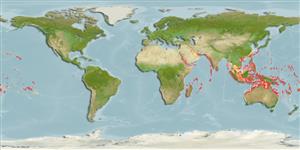
เกี่ยวกับทะเล,น้ำเค็ม; กร่อย เกี่ยวกับหินโสโครก; สัตว์น้ำที่อาศัยและอพยพภายในทะเลเท่านั้น (Ref. 51243); ระดับความลึก 0 - 50 m (Ref. 5213). Tropical; 30°N - 33°S, 30°E - 130°W
Indian Ocean.
ความยาวเมื่อครบกำหนดครั้งแรก / ขนาด / น้ำหนัก / อายุ
วัยเจริญพันธุ์: Lm 15.0 range ? - ? cm
Max length : 40.0 cm TL เพศผู้/กระเทย; (Ref. 2334)
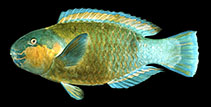
เงี่ยงครีบหลัง (รวม) : 9; ก้านครีบอ่อนที่หาง (รวม) : 10; เงี่ยงครีบก้น: 3; ก้านครีบอ่อนที่ก้น: 9. Initial phase very variable in coloration. Small individuals may be uniformly dark brown to light gray with or without the dark-centered light area on the caudal peduncle; large individuals may have a series of irregular rows of small light spots posteriorly or have the dark-centered light area on the caudal peduncle. The terminal phase is also variable with or without a large tan area on the side or on the caudal peduncle. Rounded snout (Ref. 48636).
Body shape (shape guide): fusiform / normal; Cross section: compressed.
One of the most widespread parrotfishes, but highly variable and some geographical forms that are probably subspecific (Ref. 48636). Inhabit both coral rich (Ref. 58652) and open pavement areas of shallow reef flats and lagoon and seaward reefs (Ref. 5213), as well as drop-offs, behaving differently in various areas (Ref. 48636). Benthopelagic (Ref. 58302). Juveniles found in coral rubble areas of reef flats and lagoons (Ref. 9710). Juveniles and individuals in the initial phase form large groups that migrate great distances between feeding and sleeping grounds (Ref. 9710). Feed on benthic algae (Ref. 30573). Minimum depth range reported taken from Ref. 30874. Protogynous (Ref. 55080). Minimum depth from Ref. 58018.
วงจรชีวิตและพฤติกรรมการผสมพันธุ์
วัยเจริญพันธุ์ | การสืบพันธุ์ | การวางไข่ | เซลสืบพันธ์ของเพศเมีย(ไข่) | ความดกของไข่ | ตัวอ่อน
Oviparous, distinct pairing during breeding (Ref. 205). Size at sex change: 35.1 - 47.2 cm TL (Ref. 55080).
Eschmeyer, W.N., 1997. PISCES. Eschmeyer's PISCES database as published on the Internet in June 1997, URL: gopher://gopher.calacademy.org:640/7. (Ref. 12965)
สถานะบัญชีแดงของ IUCN (Ref. 130435: Version 2025-2 (Global))
ภัยคุกคามต่อมนุษย์
Reports of ciguatera poisoning (Ref. 31637)
การใช้ของมนุษย์
การประมง: การค้า; สถานที่แสดงสัตว์และพืชน้ำ: การค้า
เครื่องมือ
รายงานพิเศษ
ดาวน์โหลด XML
แหล่งที่มาจากอินเตอร์เน็ต
การประมาณค่าตามแบบจำลอง
อุณหภูมิที่ต้องการ (อ้างอิง
123201): 24.6 - 28.8, mean 27.5 °C (based on 582 cells).
ดัชนีความหลากหลายทางวิวัฒนาการ (อ้างอิง
82804): PD
50 = 0.5000 [Uniqueness, from 0.5 = low to 2.0 = high].
Bayesian length-weight: a=0.01413 (0.01207 - 0.01653), b=3.06 (3.02 - 3.10), in cm total length, based on LWR estimates for this species (Ref.
93245).
ระดับชั้นอาหาร (อ้างอิง
69278): 2.6 ±0.29 se; based on food items.
ความสามารถในการกลับคืนสู่ปกติ (อ้างอิง
120179): ขนาดกลาง, เวลาต่ำสุดที่จะทำให้ประชากรเพิ่มขึ้นเป็น 2 เท่าใช้เวลา 1.4 - 4.4 ปี (tmax=9; k >0.3).
ความเสี่ยงต่อการตกปลา (Ref.
59153): Low to moderate vulnerability (27 of 100).
🛈
สารอาหาร (Ref.
124155): Calcium = 40.5 [17.6, 133.5] mg/100g; Iron = 0.726 [0.311, 1.762] mg/100g; Protein = 19.1 [17.2, 20.9] %; Omega3 = 0.112 [0.056, 0.221] g/100g; Selenium = 46.3 [16.3, 119.9] μg/100g; VitaminA = 30 [10, 92] μg/100g; Zinc = 2.46 [1.10, 4.16] mg/100g (wet weight); based on
nutrient studies.