>
Eupercaria/misc (Various families in series Eupercaria) >
Labridae (Wrasses) > Julidinae
Etymology: Halichoeres: Greek, als, alis = salt + Greek, choiros = pig (Ref. 45335).
Eponymy: Dr Joseph Hartzfeld (1815–1885) was a German physician who was a Principal Medical Officer of the Royal Dutch East Indies Army (1841–1869). [...] (Ref. 128868), visit book page.
More on author: Bleeker.
Umwelt: Milieu / Klimazone / Tiefenbereich / Verbreitungsgebiet
Ökologie
seewasser riff-verbunden; tiefenbereich 10 - 70 m (Ref. 12472). Tropical
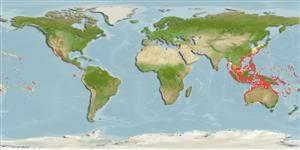
Western Pacific: tropical, north to southern Japan; may ultimately be regarded as a subspecies of Halichoeres zeylonsis of the Indian Ocean. Also recorded from Indonesia, Mentawai Island (Ref. 5978).
Größe / Gewicht / Alter
Geschlechtsreife: Lm ? range ? - ? cm
Max length : 18.0 cm TL Männchen/unbestimmt; (Ref. 9002); max. veröff. Gewicht: 82.64 g (Ref. 124708)
Rückenflossenstacheln (insgesamt) : 9; Rückenflossenweichstrahlen (insgesamt) : 11; Afterflossenstacheln: 3; Afterflossenweichstrahlen: 11. Juveniles are off-white with a broad yellow lateral band.
Body shape (shape guide): fusiform / normal.
Inhabits seaward reefs, prefers open expanses of sand or mixed sand, rubble, and pavement usually below 11 m. Occurs in loose groups of one male and numerous smaller females and juveniles. Small groups of females and males moving over large areas by themselves, regularly checking females (Ref. 48636).
Lebenszyklus und Paarungsverhalten
Geschlechtsreife | Fortpflanzung | Ablaichen | Eier | Fruchtbarkeit | Larven
Distinct pairing during breeding (Ref. 205).
Myers, R.F., 1991. Micronesian reef fishes. Second Ed. Coral Graphics, Barrigada, Guam. 298 p. (Ref. 1602)
IUCN Rote Liste Status (Ref. 130435: Version 2025-2 (Global))
Bedrohung für Menschen
Harmless
Nutzung durch Menschen
Fischereien: kommerziell; Aquarium: Kommerziell
Tools
Zusatzinformationen
Download XML
Internet Quellen
Schätzungen auf der Grundlage von Modellen
Bevorzugte Temperatur (Ref.
123201): 24.3 - 28.9, mean 27.7 °C (based on 514 cells).
Phylogenetischer Diversitätsindex (Ref.
82804): PD
50 = 0.5000 [Uniqueness, from 0.5 = low to 2.0 = high].
Bayesian length-weight: a=0.01000 (0.00475 - 0.02106), b=3.09 (2.92 - 3.26), in cm total length, based on LWR estimates for this Genus-body shape (Ref.
93245).
Trophische Ebene (Ref.
69278): 3.5 ±0.5 se; based on size and trophs of closest relatives
Widerstandsfähigkeit (Ref.
120179): hoch, Verdopplung der Population dauert weniger als 15 Monate. (Preliminary K or Fecundity.).
Anfälligkeit der Fischerei (Ref.
59153): Low vulnerability (10 of 100).
🛈
Nährstoffe (Ref.
124155): Calcium = 73.2 [44.4, 120.5] mg/100g; Iron = 0.681 [0.404, 1.233] mg/100g; Protein = 18.4 [15.6, 20.6] %; Omega3 = 0.165 [0.108, 0.252] g/100g; Selenium = 28.8 [17.7, 49.2] μg/100g; VitaminA = 132 [41, 493] μg/100g; Zinc = 1.59 [1.11, 2.49] mg/100g (wet weight);