>
Eupercaria/misc (Various families in series Eupercaria) >
Labridae (Wrasses) > Julidinae
Etymology: Thalassoma: Greek, thalassa = the sea + Greek, soma = body; the colour of the sea (Ref. 45335).
More on authors: Lay & Bennett.
Lingkungan: lingkungan / zona iklim / kisaran kedalaman / jangkauan distribusi
Ekologi
laut berasosiasi dengan karang; kisaran kedalaman 0 - 40 m (Ref. 2334), usually 1 - 5 m (Ref. 90102). Tropical; 30°N - 32°S
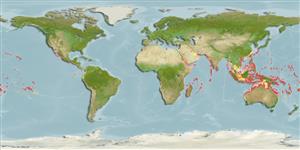
Indo-Pacific: East Africa to the Hawaiian, Marquesan, and Tuamoto islands, north to the Ryukyu Islands. Replaced by Thalassoma cupido from southern Japan to Taiwan, Thalassoma heiseri in Pitcairn, and Thalassoma loxum at Oman (Ref. 37816). Reported hybrids with Thalassoma jansenii in Banda Sea, Indonesia and with Thalassoma nigrofasciatum in Holmes Reef, Coral Sea (Ref. 57554).
Ukuran / Berat / umur
Kematangan: Lm ? range ? - ? cm
Max length : 17.0 cm TL jantan/; (Ref. 4392)
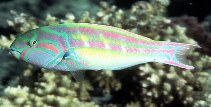
Duri punggung (Keseluruhan (total)) : 8; duri punggung lunak (Keseluruhan (total)) : 12 - 14; Duri dubur: 3; Sirip dubur lunak: 10 - 12. Males display with brilliant colors, red lines turning purple and often the abdomen bright yellow (Ref. 48636). Two uneven red stripes on dorsal half of body, 1 from below dorsal-fin origin onto upper caudal lobe, the other from above pectoral-fin base to caudal peduncle. Pectoral fins with green base and dark pectoral fins (Ref 9823).
Body shape (shape guide): fusiform / normal; Cross section: compressed.
Found in clear outer lagoon reefs (Ref. 9710) and exposed seaward reefs. Abundant in shallow exposed areas with surge channels (Ref. 9710, 48636), with gutters, large Acropora plates and algae bottom (Ref. 48636). Benthopelagic (Ref. 58302). Males are often in small loose numbers, swimming over reef sections where small groups of females stay close to the bottom. Juveniles secretive in shallow gutters (Ref. 48636). Feed mainly on benthic crustaceans (crabs, shrimps), small fishes, gastropod mollusks, and sea urchins.
Siklus hidup dan perilaku kawin
Kematangan | Reproduksi, perkembang biakan | Pemijahan | telur-telur | Fekunditas | Larva
Pelagic spawner.
Randall, J.E., G.R. Allen and R.C. Steene, 1990. Fishes of the Great Barrier Reef and Coral Sea. University of Hawaii Press, Honolulu, Hawaii. 506 p. (Ref. 2334)
Status IUCN Red List (Ref. 130435: Version 2025-2 (Global))
ancaman kepada manusia
Harmless
penggunaan manusia
Perikanan: komersial; Akuarium: Komersial
Alat, peralatan
laporan khas
muat turun XML
Sumber internet
Estimasi berdasarkan model
Suhu yang disukai (Acuan
123201): 25 - 29.3, mean 28.3 °C (based on 2873 cells).
Indeks keanekaragaman filogenetik (Acuan
82804): PD
50 = 0.5000 [Uniqueness, from 0.5 = low to 2.0 = high].
Bayesian length-weight: a=0.01000 (0.00446 - 0.02243), b=3.05 (2.88 - 3.22), in cm total length, based on LWR estimates for this Genus-body shape (Ref.
93245).
Tingkat Trofik (Acuan
69278): 3.6 ±0.56 se; based on food items.
Daya lenting (Acuan
120179): Tinggi, Waktu penggandaan populasi minimum kurang dari 15 bulan (Preliminary K or Fecundity.).
Kerentanan Penangkapan Ikan (Ref.
59153): Low vulnerability (10 of 100).
🛈
Nutrisi (Ref.
124155): Calcium = 77.5 [46.8, 130.8] mg/100g; Iron = 0.69 [0.41, 1.26] mg/100g; Protein = 18.5 [15.7, 20.7] %; Omega3 = 0.161 [0.105, 0.250] g/100g; Selenium = 25 [15, 44] μg/100g; VitaminA = 140 [44, 517] μg/100g; Zinc = 1.59 [1.10, 2.46] mg/100g (wet weight);